
The short answer
Three things move the number: how much containment the layout forces, whether the finishes can be reproduced, and whether the moisture source has actually been fixed. Square footage matters far less than people expect. A quote that does not identify and address the water source is not a quote worth comparing.
Mold remediation pricing confuses people because the obvious metric — how much mold there is — is only one of several things driving the number, and often not the largest.
Factor 1: area, which sets the protocol
| Affected area | Typical protocol | Cost bracket |
|---|---|---|
| Under ~10 sq ft of surface mildew | Homeowner cleaning plus a ventilation fix | Minimal |
| 10–100 sq ft on drywall or wood | Professional removal with full containment and negative air | Low four figures |
| Over 100 sq ft | Engineered containment, decontamination airlock, clearance testing recommended | Mid four to five figures |
| Crawl space or attic across the footprint | Confined-space contained removal plus a moisture-source fix | Five figures is common |
| HVAC system involvement | Duct cleaning or replacement as a separate scope | Adds substantially |
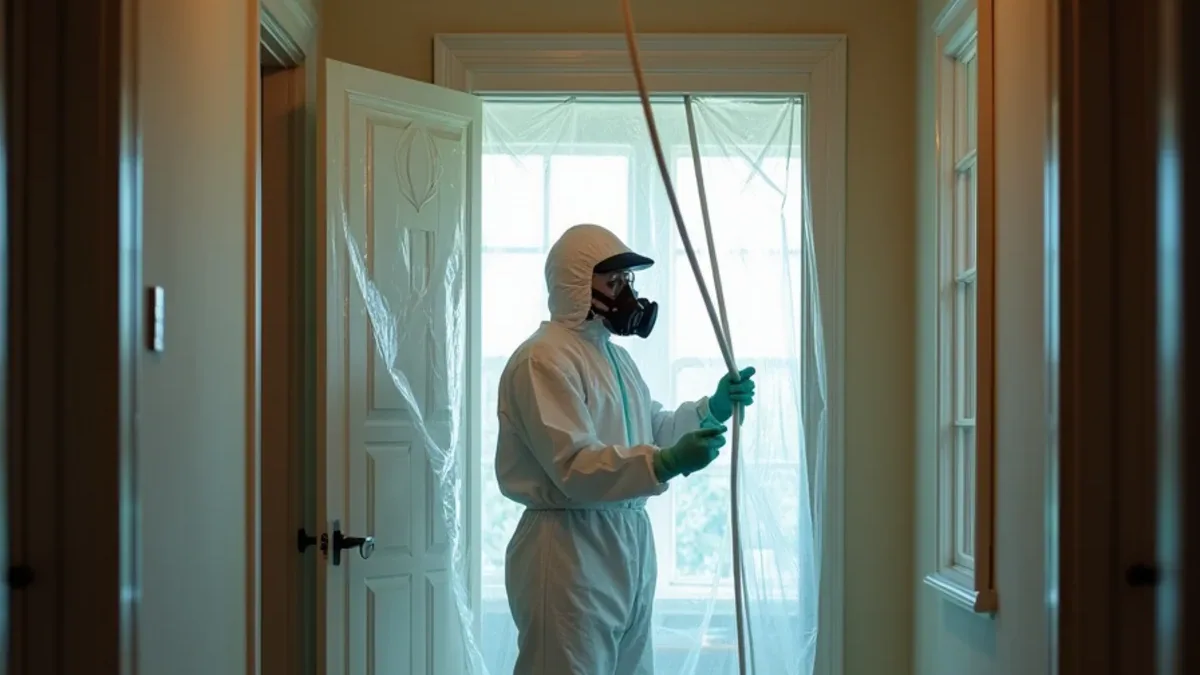
The jump from "under 10 square feet" to "over 100" is not linear, because the protocol changes rather than just the labor hours. Containment, negative air, decontamination procedures and clearance testing are largely fixed costs that apply the moment you cross into professional territory.
Factor 2: where it is
Square footage in an open room and square footage in an 18-inch crawl space are entirely different jobs. Confined-space work is slow, physically demanding, and requires more people for safety.
In rough order of cost per square foot, cheapest to most expensive: open room wall, ceiling, accessible attic, wall cavity requiring selective demolition, low-clearance crawl space, and anything requiring cabinetry or built-in millwork to be removed and refitted.
Factor 3: containment complexity
This is the factor that scales hardest in a large house, and it is invisible to most homeowners looking at a quote.
A single-room job needs one containment chamber. A job spread across two floors, or one where the family needs to keep using most of the house, needs multiple chambers, decontamination airlocks, separate negative air units, and protected transit routes. That is materials, setup labor and daily maintenance across the whole job.
Factor 4: what has to be rebuilt — usually the biggest number
In a high-value home, this dominates. Removing colonized material is a known cost. Replacing it is not.
- Standard drywall, texture and paint — inexpensive and quick.
- Custom millwork and cabinetry — has to be remade to match, and the joiner sets the timeline.
- Specialty plaster and hand-applied finishes — cannot be patched invisibly; often the whole plane goes.
- Stone and large-format tile — lifting without breaking is skilled work, and discontinued material may be unmatchable.
- Wide-plank or reclaimed hardwood — frequently irreplaceable, which changes the whole approach.
On the $2M-plus properties through Lower Happy Valley and the surrounding Lafayette hillside neighborhoods, the rebuild is routinely several times the remediation itself.
Factor 5: the moisture source
Remediation without fixing the cause is money wasted, and we will not quote one without the other. What the fix costs varies enormously:
A bathroom extractor fan vented properly is trivial. A vapor barrier in a crawl space is modest. A failed shower pan means opening a bathroom. Exterior drainage remediation on a hillside lot — a new French drain, regrading, retaining wall drainage — is a separate trade and a separate budget entirely.
The insurance number that matters most
Many California homeowners policies carry a specific mold sublimit — commonly $5,000 or $10,000 — that applies regardless of your dwelling limit. Find it on your declarations page before work starts, not after.
Coverage generally attaches when the mold resulted directly from a covered sudden water loss that was reported and addressed promptly. It generally does not attach when it resulted from a long-term leak, chronic humidity or deferred maintenance — which is the majority of the mold we find.
High-value carriers such as Chubb and PURE often carry higher mold limits than standard-market policies, which is worth knowing if you are insured with one.
Where you can legitimately save
- Catch it early. A wall cavity caught at three months and one caught at three years are different jobs. Act on a musty smell rather than living with it.
- Fix the moisture source first, even if remediation has to wait a few weeks. Growth stops progressing once the material dries.
- Do not over-test. Sampling that does not change the protocol is money spent on paper. Area and material drive the scope.
- Be realistic about what is worth saving. Sometimes replacing a whole plane is cheaper than heroic efforts to match a patch.
- Get clearance testing from an independent hygienist, not from the company doing the work. That is not a saving, but it is the difference between paying for a result and paying for an opinion.
See mold remediation in Lafayette for what the process involves, and call +1 (201) 277-9344 for an inspection.
Frequently asked
Why do mold remediation quotes vary so much for the same amount of mold?
Because area is only one factor. Where it is matters enormously — an 18-inch crawl space costs far more per square foot than an open room wall. Containment complexity scales with how much of the house must stay usable. And in a high-value home, the rebuild — matching custom millwork, specialty plaster, stone or irreplaceable hardwood — is routinely several times the remediation itself.
Does insurance cover mold remediation in California?
Generally when the mold resulted directly from a covered sudden water loss that was reported and addressed promptly, and generally not when it resulted from a long-term leak, chronic humidity or deferred maintenance. Critically, many California policies carry a specific mold sublimit — commonly $5,000 or $10,000 — regardless of the dwelling limit. Find that number on your declarations page before work starts.
Should I pay for mold testing?
Only where it changes what gets done. Species identification rarely alters the remediation protocol — area and material drive that. Where testing genuinely earns its cost is post-remediation clearance on a substantial job, and that should come from an independent hygienist rather than the company that did the work, because a firm that both writes and passes its own protocol has an obvious conflict.
Can I reduce the cost by doing some of it myself?
For surface mildew under about ten square feet on non-porous surfaces, yes — clean it and fix the ventilation. Beyond that, no, and attempting it usually costs more. Disturbing colonized porous material without containment and negative air spreads spores through the rest of the house, which converts a one-room job into a whole-house one.