

The leaks that cost the most are the ones nobody can see. A pinhole in a copper line inside a wall, a hot-water line failing under a slab, an irrigation main weeping into the hillside — they run for months, quietly soaking framing and quietly doubling your EBMUD bill.
We locate them without opening the building first. Acoustic listening, thermal imaging, moisture mapping, pressure isolation and tracer gas — used in the right order for the kind of leak you have. Call +1 (201) 277-9344.
Signs you need leak detection & repair coordination
If you recognize two or more of these, the problem is already past the point where waiting is cheaper.
A water bill that stepped up suddenly
The clearest single sign. Compare against the same month last year, not last month.
A warm patch on a slab floor
Hot-water slab leak, and it should be located before the concrete and soil beneath are undermined further.
Running water audible with everything off
Stand in the quietest part of the house at night. If you can hear it, it is significant.
Damp or discoloured drywall with no obvious source
A supply line inside the cavity, or water tracking from somewhere else along a top plate.
An unusually green or soft patch in the yard
Buried irrigation or service line. Common on the larger landscaped lots here.
Low water pressure across the whole house
Significant loss somewhere upstream of the fixtures.
Signs you have a leak you cannot see
Most people who call us have noticed two or three of these and put off doing anything for a few weeks. That is normal, and it is also exactly the window where the cost of the eventual repair triples.
- A water bill that jumped with no change in usage. The most reliable single indicator. A continuously running leak shows up as a step change, not a gradual drift.
- A warm spot on a slab floor. Almost always a hot-water slab leak. Sometimes felt through tile before it is visible anywhere.
- The sound of running water with every fixture off. Stand still in a quiet house at night. If you can hear it, it is real.
- A musty smell with no visible source. Something has been wet long enough to grow.
- Persistently damp or discoloured drywall, or paint that will not stop bubbling.
- A patch of the yard that is greener, softer or growing faster than everything around it — a buried irrigation or service line leak.
- Reduced water pressure across the house without an obvious cause.
- Cracks appearing in slab, tile or stucco — long-running subsurface leaks undermine soil and move foundations.
How we find it without demolishing your house
Acoustic detection
Pressurized water escaping through a small opening makes a distinctive sound that travels through pipe and through the surrounding material. Ground microphones and amplified listening equipment let us follow that sound and narrow the source to within a small area — often close enough to open a single 30cm square rather than a whole floor. Works best on pressurized supply lines, which is most of what we chase.
Thermal imaging
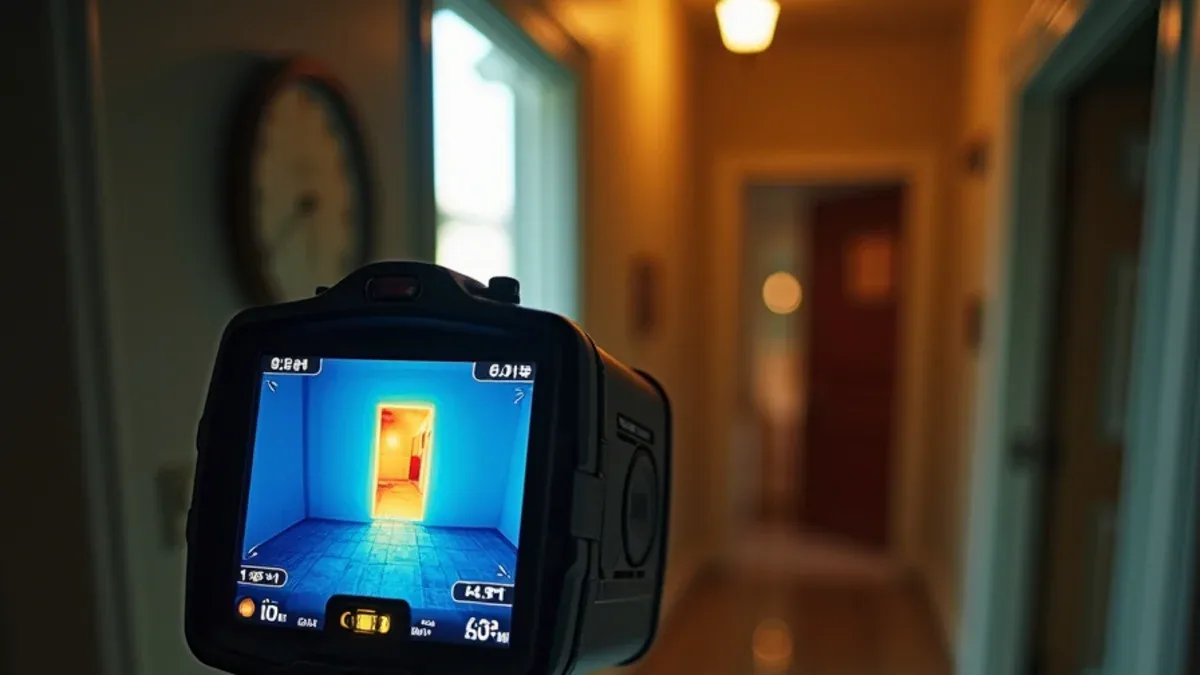
A hot-water leak under a slab warms the concrete above it in a line you can see clearly on an infrared camera. Cold-water leaks show as evaporative cooling. Thermal is also how we map the extent of a wall cavity leak before deciding where to cut.
Moisture mapping
Pinless meters across the whole suspect area produce a contour of where the material is wettest. The wettest point is not always the leak — water runs — but combined with acoustic and thermal it triangulates well.
Pressure isolation testing
By isolating sections of the system and pressure testing them individually, we determine whether the leak is on hot or cold, on supply or on irrigation, and which branch. This is the step that stops a search from wandering.
Tracer gas
For the hardest cases — a leak under a thick slab, or a line under hardscape — we introduce an inert hydrogen-nitrogen mix into the drained line and follow it to the surface with a gas detector. It is the most precise method available and it is what we reach for when acoustics are defeated by ambient noise or by depth.
The leaks we find most often here
| Leak type | Where we see it in Lafayette | Usual first symptom |
|---|---|---|
| Copper pinhole in a wall | Homes built 1955–1975 across most of town | Bubbling paint or a damp patch of drywall |
| Hot-water slab leak | Slab-on-grade tracts — De La Fuente, the Pleasant Hill border | A warm patch on the floor and a bill spike |
| Angle stop / supply line at a fixture | Every era of housing | Cabinet base swelling, a stain on the vanity floor |
| Irrigation main or lateral | Larger landscaped lots in Happy Valley and Orinda | A very green patch of lawn, a soft area in the yard |
| Shower pan or tub surround failure | Original 1960s–70s bathrooms | Ceiling stain in the room below |
| Water heater relief valve or tank seep | Attached garages, town-wide | A slow damp line across the garage slab |
| Sewer lateral leak | Wooded lots with mature oaks and bays | Soggy ground and odor over the line |
What happens after we find it
We are a restoration company, not a plumbing contractor, and we would rather be straightforward about that division. Finding the leak and drying the damage is our work. Cutting out and replacing the failed pipe is a licensed plumber's work.
In practice that means we mark the exact location, provide the written detection report and photographs, and coordinate directly with your plumber — or one of the local plumbers we work with regularly — so nobody is opening the floor twice. Once the repair is made we handle the drying and put the building back. See slab leak water damage restoration for what that looks like on a slab job.
On insurance: California policies generally cover the resulting damage from a sudden pipe failure, and generally do not cover the cost of the pipe repair itself. Many will also cover the "tear-out and access" needed to reach the pipe. A written detection report showing you found the leak promptly and acted on it is exactly the documentation that keeps that conversation short.
You do not need to know what to ask for
You do not have to know whether this is leak detection & repair coordination, extraction, mitigation or a full restoration — those are stages of one job and sorting out which you need is our work, not yours.
A local person answers
Not a call center selling your emergency on to whoever bids for it.
First question
Has the water stopped? Everything about leak detection & repair coordination changes depending on whether it is still arriving.
Then we move
60-minute dispatch, and we talk you through the shutoff while the crew is loading.
Free, no-obligation inspection with moisture readings and a written assessment. We bill your insurer directly.
Our leak detection & repair coordination process
Six steps, documented at every stage, with the daily readings that prove it.
Interview and history
Bill history, when it started, what changed, what has already been checked.
Meter and isolation test
Confirm there is a leak and determine which system it is on.
Non-invasive survey
Thermal imaging and moisture mapping across the suspect area.
Acoustic pinpointing
Ground microphones and amplified listening to narrow the location.
Tracer gas if needed
For deep, hardscaped or acoustically difficult locations.
Mark, report, coordinate
Exact location marked, written report with photos, plumber coordinated, drying scheduled.
What drives the price
We are not going to quote a number over the phone — nobody can scope a water loss without walking the property. These are the factors that decide it.
- Which methods the leak requires
- A straightforward acoustic find is quick. Tracer gas under a hardscaped slab takes considerably longer and needs the line drained.
- Size of the search area
- A single suspect bathroom is a different job than a 4,000 sq ft house with no localizing symptom.
- Access
- Fixed cabinetry, stone flooring, finished basements and tight crawl spaces all slow the survey.
- Ambient noise
- Acoustic detection near a busy road or with equipment running is harder and sometimes pushes the job to tracer gas.
- Whether damage has already occurred
- If material is already wet, detection is usually rolled into the mitigation scope rather than billed separately.
- Report and coordination
- A written report with photographs and marked locations for your plumber and your insurer.
Why choose Water Lafayette for leak detection & repair coordination
Not the generic badges every restoration site carries — the things that actually change the outcome on this particular job.
Four methods, used in the right order
Pressure isolation to establish which system, thermal to narrow it, acoustic to pinpoint, and tracer gas when the first three are defeated by depth or ambient noise. Most outfits carry one.
Located to within about six inches
Precise enough that the plumber opens one small area. The alternative is exploratory demolition — we have attended houses with two openings already cut in the wrong walls.
You get a written report with the mark
Photographs, the marked location and the method used. Your plumber is not searching, and your carrier has documentation that you found it promptly.
We are honest about the trade boundary
We locate the leak and dry the damage. The pipe repair is licensed plumbing work. We coordinate directly with yours so the floor is opened once rather than three times.
We start with the free tests
The meter test and isolating the water heater cost nothing and rule out half the possibilities. We will walk you through both on the phone before booking anything.
Licensed and insured California contractor · IICRC-certified to the S500 water damage and S520 mold remediation standards · 60-minute dispatch across Lafayette and Lamorinda · Based at 3450 Golden Gate Way, Lafayette, CA 94549.
Leak Detection & Repair Coordination FAQs
How do you find a leak without breaking anything?
We combine four non-invasive methods: acoustic listening equipment that hears pressurized water escaping through pipe and material, thermal imaging that sees the temperature signature of a hot-water leak or evaporative cooling from a cold one, moisture mapping that contours where materials are wettest, and pressure isolation testing that identifies which line is involved. For the hardest cases we use tracer gas. Between them we can normally mark a location precisely enough that only a small opening is needed.
What does a hidden leak actually cost me if I wait?
Two ways. Directly, a continuously running leak can add hundreds of dollars a year to an EBMUD bill on a larger property. Indirectly and far more expensively, a leak that soaks framing and insulation for months turns a plumbing repair into a mold remediation, and a slab leak that undermines soil for a year can move the foundation. The repair is the same either way; everything else scales with time.
Do you fix the leak too?
We locate the leak, document it and dry the resulting damage. The pipe repair itself is licensed plumbing work, so we coordinate directly with your plumber or one of the local plumbers we work with regularly, hand over the exact marked location and the detection report, then handle the drying and reinstatement once the repair is complete. That sequence means the floor or wall is opened once, not three times.
Will my insurance pay for leak detection?
It varies by policy. Many California homeowners policies cover the "tear-out and access" required to reach a leaking pipe and the resulting water damage, while excluding the cost of the pipe repair itself. Some carriers reimburse detection as part of that access cost. A written detection report showing prompt action helps significantly, both for that line item and for the resulting-damage claim.
My water bill doubled but I cannot see anything. Where do I start?
Do the meter test first. Shut off every water-using fixture and appliance including the ice maker and the irrigation controller, note the meter reading, and check it 30 minutes later. Movement means a leak between the meter and the house. On larger Lafayette properties with extensive landscaping, irrigation is the most common culprit — shut off the irrigation valve specifically and repeat the test to isolate it.
Related reading
Hidden Leak Symptoms: Warm Floor Spots, High Water Bills, and the Sound of Running Water
The leaks that cost the most are the ones nobody sees. They give clear signals for months — here they are, and here is how to confirm one in five minutes.
ReadSpike in Your EBMUD Water Bill? You Might Have a Hidden Leak Behind the Walls
A bill that steps up between one period and the next is the single most reliable early signal of a hidden leak — and the most useful evidence you can have later.
Read