

A sewage backup is not a mess to clean up — it is a contamination event. Category 3 water carries bacteria, viruses and parasites, and the moment it touches a porous material, that material is finished. Getting this wrong leaves pathogens in the building and odor that comes back every warm day.
We handle backups the way the standard requires: containment before anything else, full PPE, contaminated material out and bagged, hard surfaces cleaned then disinfected, air scrubbed, structure dried and verified. Call +1 (201) 277-9344.
Signs you need sewage cleanup & backup removal
If you recognize two or more of these, the problem is already past the point where waiting is cheaper.
Waste water coming up through a floor drain or shower
The lowest fixture in the house is where a blocked lateral always surfaces first.
Multiple slow drains at once
One slow sink is a trap. Several fixtures together means the lateral or the main.
A toilet gurgling when the washer or shower drains
Air being displaced past a blockage. This is the early warning before a full backup.
Sewage odor indoors or at the cleanout
Especially after rain, which points to infiltration and surcharge.
Wet soggy patch in the yard over the lateral line
A failed or root-invaded lateral leaking below ground.
Flood water with a sewage smell
Treat the whole event as Category 3 — a lateral or main surcharged upstream.
Get everyone out of the affected area first
Before anything else: close the door on it. Children and pets out of the space entirely, HVAC off if a return or supply register is in the affected area, and nobody walks through it and then through the rest of the house.
- Stop using every fixture in the house. Every flush, every load of laundry, every dishwasher cycle adds more volume to a system that is already blocked.
- Do not run the HVAC if it draws air from the affected area — it will distribute contaminated aerosols building-wide.
- Do not attempt to clean it with household products. Bleach on a porous surface sterilizes the top layer and does nothing to the contamination underneath, and mixing cleaners produces genuinely dangerous gas.
- Photograph it from the doorway for your claim, then leave it alone.
- Call us, and call a plumber for the blockage itself if you have not already. We coordinate with yours or bring one in.
Why backups happen so often on Lafayette lots
Tree roots in the lateral
This is the single most common cause we see here, and it is a direct consequence of what makes these neighborhoods desirable. Mature coast live oaks and California bays send fine roots toward any moisture source, and an older clay or cast-iron sewer lateral leaks just enough at the joints to attract them. The roots enter, thicken, and catch solids until the line blocks completely. Wooded lots in Happy Valley, Reliez Valley, Oak Hill Road and across Orinda are the recurring addresses.
Aging laterals on 1950s–70s housing stock
Vitrified clay pipe installed with mortar joints, and cast iron that has scaled and lost most of its bore, are both well past design life across the mid-century tracts. Bellies form where the ground has settled, solids collect in the low spot, and eventually the line backs up.
Storm surcharge
During a heavy atmospheric river, groundwater infiltration into old laterals and mains raises flow across the whole system. A line that copes fine in September can surcharge in February, which is why sewage backups cluster during storms — and why storm flooding that smells of sewage is very often exactly that. See flood cleanup.
Grease, wipes and the usual suspects
Cooking grease congeals in a cold lateral. "Flushable" wipes are not flushable and do not break down. Combined with a partial root intrusion, either one finishes the job.
How we clean up a Category 3 loss
Contain before you touch anything
Zippered poly barriers around the affected area and negative air pressure with HEPA-filtered air scrubbers exhausted outside. Everything after this happens inside the containment, so contamination cannot migrate into clean parts of the house.
Full PPE and a clean route
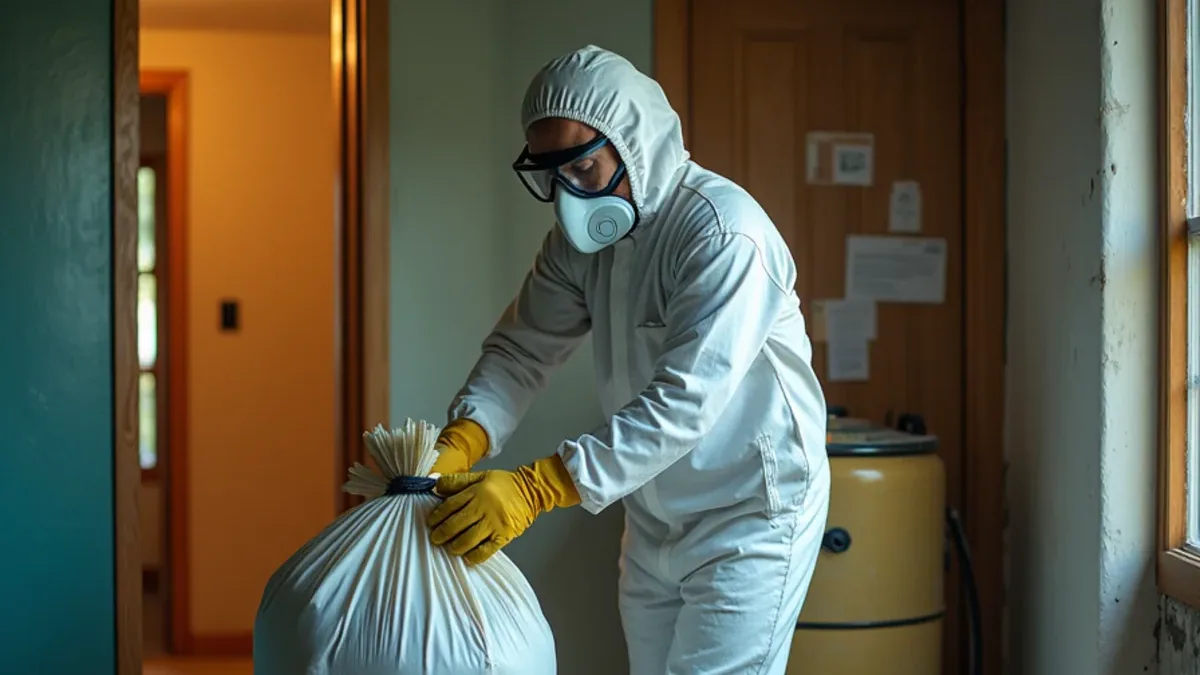
Coveralls, gloves, boots and respirators, with a defined path in and out. Waste leaves in sealed bags along that route only.
Extract and remove solids
Contaminated water extracted to a dedicated waste tank and disposed of through an approved connection. Solids removed and bagged.
Remove all affected porous material
Carpet, pad, affected drywall cut above the wick line, insulation, particleboard cabinet bases, any upholstered item that was touched. There is no drying-in-place option for porous material in Category 3 — the contamination is inside the material, not on it.
Clean, then disinfect
Two separate steps in that order. Detergent cleaning first, because disinfectant does not work through organic soil, then an EPA-registered antimicrobial applied at the correct dwell time. Framing, subfloor and every hard surface inside the containment.
Odor: remove the source, then treat the air
Persistent sewage odor always means residual contamination somewhere. We find it rather than mask it, then run HEPA filtration and, where warranted, hydroxyl or ozone treatment on an unoccupied space.
Dry, verify, rebuild
Full monitored structural drying, post-remediation verification, and a documented scope to put the space back.
What it costs and what insurance does
Category 3 mitigation runs roughly $7.00 to $7.50 per square foot, roughly double a clean-water loss, before any rebuild. The driver is not the water — it is the PPE, the containment, the disposal, and the fact that essentially every porous material in the affected area has to be replaced rather than dried.
On insurance: many California homeowners policies exclude sewer and drain backup unless a specific endorsement was added, which is typically an inexpensive add-on that most people do not know they declined. If a covered peril caused the backup — for example a sudden pipe failure — coverage may attach differently. Check your declarations page for a "water backup" or "sewer backup" endorsement and its sublimit, which is often capped well below your dwelling limit.
Preventing the next backup
- Get the lateral camera-inspected if the house is on its original line, especially on a lot with mature oaks. A scope is inexpensive relative to a Category 3 cleanup.
- Watch for the warning signs — slow drains across multiple fixtures, gurgling in a toilet when the washer drains, a smell at the cleanout after rain. Multiple fixtures is the tell that it is the lateral, not a single trap.
- Consider a backwater valve. It closes automatically if flow reverses and is the single most effective protection against a main-line surcharge.
- Keep grease and wipes out of the system, and know where your cleanout is before you need it.
You do not need to know what to ask for
You do not have to know whether this is sewage cleanup & backup removal, extraction, mitigation or a full restoration — those are stages of one job and sorting out which you need is our work, not yours.
A local person answers
Not a call center selling your emergency on to whoever bids for it.
First question
Has the water stopped? Everything about sewage cleanup & backup removal changes depending on whether it is still arriving.
Then we move
60-minute dispatch, and we talk you through the shutoff while the crew is loading.
Free, no-obligation inspection with moisture readings and a written assessment. We bill your insurer directly.
Our sewage cleanup & backup removal process
Six steps, documented at every stage, with the daily readings that prove it.
Contain and go negative
Poly barriers and HEPA-filtered negative air before any work starts.
Extract and remove waste
Contaminated water and solids removed to approved disposal.
Strip porous materials
Carpet, pad, affected drywall, insulation and particleboard out and bagged.
Clean then disinfect
Detergent cleaning first, then EPA-registered antimicrobial at full dwell time.
Eliminate the odor source
Locate residual contamination, treat the air, verify by smell and by test.
Dry and verify
Monitored drying to a dry standard, post-remediation verification, documented handover.
What drives the price
We are not going to quote a number over the phone — nobody can scope a water loss without walking the property. These are the factors that decide it.
- Category 3 protocol across the whole job
- PPE, containment, negative air and regulated disposal apply to every hour on site.
- Area affected and how far it spread
- Water travels under walls into adjoining rooms; the contaminated footprint is usually larger than the visible one.
- Volume of porous material to remove
- Carpet, drywall, insulation and cabinetry all come out. This is the largest single line on most backups.
- Disposal costs
- Contaminated water and material go to regulated disposal, which is billed by volume.
- Odor treatment
- Severe or long-standing contamination may need extended air treatment on an unoccupied space.
- Plumbing repair coordination
- Clearing the blockage, camera inspection and any lateral repair are separate plumbing costs we coordinate but do not perform.
Why choose Water Lafayette for sewage cleanup & backup removal
Not the generic badges every restoration site carries — the things that actually change the outcome on this particular job.
Containment before anything else
Sealed barriers and negative air with HEPA filtration go up before a single gallon is extracted. Crews that start extracting and contain afterwards have already moved aerosols through your house.
Clean, then disinfect — two steps, that order
Detergent cleaning first, because disinfectant does not work through organic soil, then an EPA-registered antimicrobial at full dwell time. IICRC S500 is explicit about the sequence and it is routinely skipped.
We remove the odor source rather than mask it
Persistent sewage smell weeks later always means residual contamination somewhere the cleanup missed. We find it. Fogging over the top of it is a delay, not a fix.
We document where the blockage was
In most Contra Costa jurisdictions you own the lateral to the main — but if the public main surcharged, the agency may be liable. That distinction is only useful if someone recorded it.
We will tell you the lateral needs scoping
On a wooded Lafayette lot a repeat backup is root intrusion, not luck. Rootering resets the clock; a camera inspection costs a fraction of a second Category 3 cleanup.
Licensed and insured California contractor · IICRC-certified to the S500 water damage and S520 mold remediation standards · 60-minute dispatch across Lafayette and Lamorinda · Based at 3450 Golden Gate Way, Lafayette, CA 94549.
Sewage Cleanup & Backup Removal FAQs
Can I clean up a small sewage backup myself?
We would strongly advise against it even for a small area. Sewage carries E. coli, hepatitis A, giardia and other pathogens, exposure happens through skin contact and inhaled aerosols, and household disinfectant on a porous surface does not reach the contamination inside the material. Without containment and negative air you also spread aerosols into the rest of the house while you work. If you must be in the area at all, wear gloves, boots and a respirator and stay out otherwise.
Why do you have to remove my carpet and drywall for a sewage backup?
Because Category 3 contamination is inside porous material, not on top of it. Carpet backing, pad, drywall paper facing and fiberglass insulation cannot be reliably decontaminated no matter what is sprayed on them, and residual bacteria is exactly what produces the odor that returns every warm day. Non-porous surfaces such as tile, concrete and sealed wood are cleaned, disinfected and kept.
Does homeowners insurance cover a sewage backup in California?
Often only with a specific water backup or sewer backup endorsement, which is a low-cost add-on many policies do not include by default and which usually carries a sublimit well below the dwelling limit. Check your declarations page for that line. Where a covered peril caused the failure, coverage may attach differently. We document the loss thoroughly either way and bill the carrier directly when there is coverage.
Why does my Lafayette house keep backing up?
On wooded lots here it is usually roots. Mature coast live oaks and bays send fine roots toward the moisture leaking from an older clay or cast-iron lateral, then thicken inside the pipe and catch solids. Repeat backups a few months apart almost always mean the lateral itself needs camera inspection and probably lining or replacement — clearing it again just resets the clock.
How long will the smell last after sewage cleanup?
If the job is done properly, the odor should be gone when we finish and it should not come back. Persistent sewage smell weeks later always means residual contamination somewhere the cleanup did not reach — commonly under a cabinet toe-kick, inside a wall cavity, in subfloor seams, or in HVAC ducting that ran during the event. We locate and remove the source rather than masking it, and we treat ducting where it was involved.
Related reading
Sewage Backing Up Into the Shower: Causes, Health Risks, and Safe Cleanup
If waste water is coming up out of your shower, the shower is not the problem. Water finds the lowest opening in a blocked system, and yours is on the bathroom floor.
ReadTree Roots in Your Sewer Line: Warning Signs to Catch Before the Backup
Root intrusion takes years to block a line and gives clear warnings for months beforehand. Almost nobody acts on them, because the signs are easy to explain away.
Read