

Most water damage in a home is not one problem. It is a plumbing problem, a drying problem, a contents problem, an insurance problem and eventually a construction problem, and the usual experience is being handed between four companies who each blame the last one.
We run the whole thing. One project manager, one scope, one file. Call +1 (201) 277-9344 for a free on-site inspection.
Signs you need residential water damage restoration
If you recognize two or more of these, the problem is already past the point where waiting is cheaper.
You have already been handed between three companies
Mitigation, plumbing and rebuild treated as unrelated jobs. One scope and one project manager fixes this.
Drying equipment left with no readings taken
A job in progress that will not be documented well enough for the claim.
A rebuild quote that does not match the mitigation scope
A sign the two were written by people who never spoke to each other.
Contents piled in a garage with no inventory
Unrecoverable on a claim, and a mold risk if anything was damp.
Your adjuster asking for documentation you do not have
The moisture log, the photo set and the line-item scope should already exist.
A musty smell weeks after a "completed" job
It was not dried to a standard. It needs reopening, not repainting.
What "full service" means in practice
From the first call to the last coat of paint, here is what sits inside our scope and what does not — because knowing the boundary up front saves everyone time.
| Phase | What happens | Who does it |
|---|---|---|
| Emergency response | Extraction, source control, contents protection | Us |
| Plumbing or roofing repair | Replacing the failed pipe, fixing the roof | Licensed plumber or roofer — we coordinate |
| Mitigation | Controlled demolition, drying, monitoring, antimicrobial | Us |
| Contents | Pack-out, inventory, cleaning, storage, return | Us, with specialists for documents and textiles |
| Mold remediation | Containment, removal, clearance where established | Us — see mold remediation |
| Insurance | Documentation, adjuster liaison, direct billing | Us |
| Rebuild | Drywall, texture, paint, flooring, trim, cabinetry | Us, with trade partners for specialty finishes |
| Final walkthrough | Readings reviewed, documentation handed over | Us |
Lafayette housing stock, room by room
A 1962 ranch on a slab in De La Fuente and a 2004 custom build on a hillside in Acalanes Ridge fail in completely different ways and need completely different drying approaches. This is what we adjust for.
1950s–1970s ranches and split-levels
The bulk of the town. Original copper at pinhole age, galvanized branch lines in some, acoustic ceilings that may contain asbestos, oak strip flooring that is worth saving and can usually be saved with mat drying, and raised foundations over crawl spaces. The recurring losses are supply-line failures, garage water heaters and crawl space intrusion.
1980s–1990s builds
More second stories, more upstairs laundries and bathrooms, which means more losses that travel down through ceilings into two floors. Often the first generation of engineered flooring, which does not survive saturation.
2000s and newer custom homes
Larger, more complex, more finish value at risk. Wide-plank hardwood, stone, custom millwork, integrated AV and smart home wiring, wine storage, and multi-zone HVAC. Losses here are less frequent and much more expensive per event, and the drying has to be gentler and longer because the finishes are unforgiving.
Hillside construction generally
Stepped foundations, split-level floors, retaining walls, and drainage systems doing real work every winter. Water arriving from uphill, and access that makes every phase of the job slower.
Your contents, handled properly
The building is replaceable. Most of what is upsetting about a water loss is not the drywall.
- Pack-out and inventory. Where a room has to be cleared, everything is photographed, tagged and logged before it moves, and it comes back to the same room.
- Triage by material. Hard non-porous goods clean up well. Upholstery, mattresses and anything porous exposed to Category 3 does not, and we say so plainly rather than pretending.
- Documents and photographs. Wet paper is time-critical. There are specialist freeze-drying processes that recover documents and photographs that look unsalvageable — but only if they are frozen before mold establishes. Tell us on day one if there is anything irreplaceable.
- Rugs and textiles. Oriental and wool rugs go to a specialist facility rather than being dried in place, because in-place drying sets stains and causes dye migration.
- Electronics. Powered down, not tested, and assessed by a specialist. Turning on a wet device is how a recoverable item becomes a total loss.
- Art, instruments and wine. These need controlled environments rather than air movers. We arrange it.
Living in the house during the work
Most families stay. Here is what it is actually like, so you can plan.
- Noise. Air movers and dehumidifiers run 24 hours and they are loud — comparable to a bathroom extractor fan, times several. Bedrooms adjoining the work area are unpleasant. We can sometimes reposition to protect sleeping areas at night, at a small cost in drying speed.
- Heat and dryness. A drying chamber runs warm and very dry. It is uncomfortable but not harmful.
- Access. Containment barriers and taped floor protection change how you move through the house. We keep a clear route to the kitchen and bathrooms wherever possible.
- Daily visits. Someone needs to be home, or we need a key or a code, for monitoring visits. We schedule them at the same time each day.
- Power. Drying equipment draws significant current. We spread the load across circuits, but a house with an older panel occasionally needs a temporary distribution arrangement.
- When to leave. If the loss is Category 3, if a bedroom or the only bathroom is out of service, or if anyone in the household is immunocompromised, asthmatic or very young, we recommend alternative accommodation. Additional living expenses are covered under most policies — ask your adjuster on day one, not week two.
The rebuild
Mitigation gets the building dry. Rebuild puts it back, and it is usually the larger number — commonly $20 to $37 per square foot of affected area for standard finishes, and considerably more where there is custom millwork, stone or specialty plaster.
Two things we will always raise with you. First, matching. Discontinued tile, a specific hardwood run, a texture applied by a particular hand — matching is often the single hardest and most expensive part of a rebuild, and sometimes the honest answer is to replace a whole plane or a whole room rather than accept a visible join. Second, betterment. If your fifteen-year-old flooring has to come out anyway, the incremental cost to upgrade is often small, and the claim pays the like-for-like portion. We will show you the arithmetic rather than deciding for you.
We serve homeowners right across Lafayette, the Lamorinda communities and the wider Contra Costa County area.
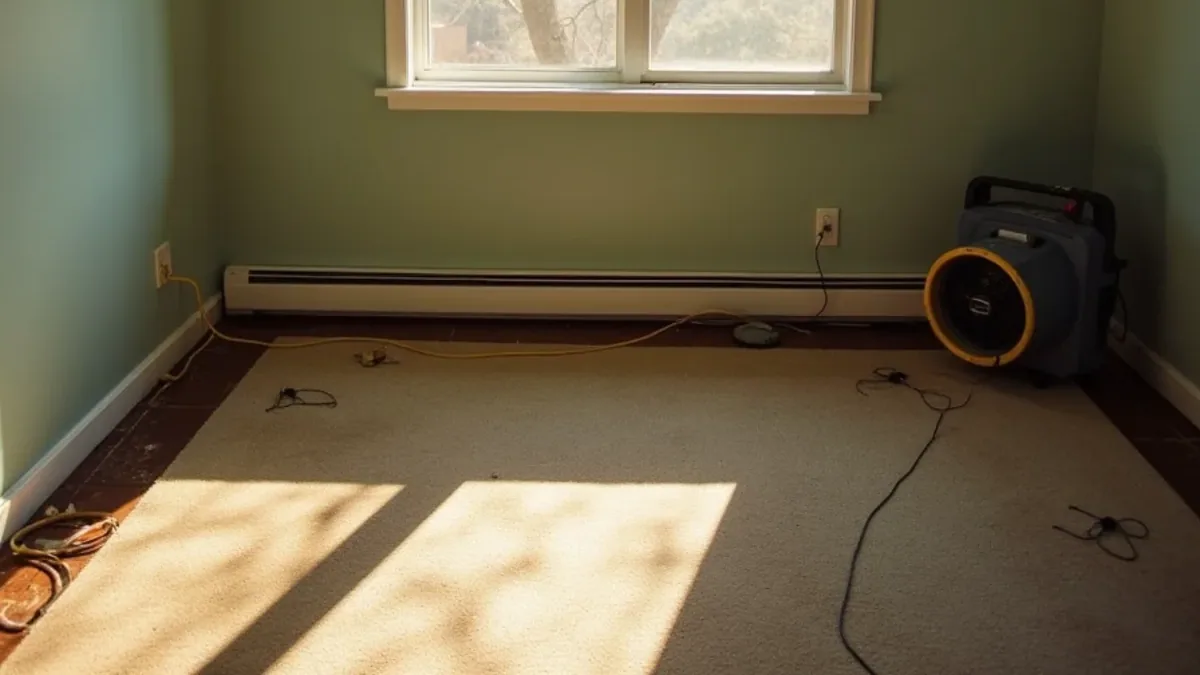
You do not need to know what to ask for
You do not have to know whether this is residential water damage restoration, extraction, mitigation or a full restoration — those are stages of one job and sorting out which you need is our work, not yours.
A local person answers
Not a call center selling your emergency on to whoever bids for it.
First question
Has the water stopped? Everything about residential water damage restoration changes depending on whether it is still arriving.
Then we move
60-minute dispatch, and we talk you through the shutoff while the crew is loading.
Free, no-obligation inspection with moisture readings and a written assessment. We bill your insurer directly.
Our residential water damage restoration process
Six steps, documented at every stage, with the daily readings that prove it.
Free on-site inspection
Moisture mapping, category and class, written scope and a real timeline.
Emergency mitigation
Extraction, controlled demolition, drying equipment set the same visit.
Contents management
Pack-out, inventory, cleaning and storage where the work requires it.
Monitored drying
Daily documented readings to a dry standard, with equipment adjusted as needed.
Insurance handled
Adjuster liaison, full evidence file, direct billing to the carrier.
Rebuild and walkthrough
Drywall through paint and flooring, then a documented handover.
What drives the price
We are not going to quote a number over the phone — nobody can scope a water loss without walking the property. These are the factors that decide it.
- Size of the affected area
- Rooms affected and levels involved. Water that reached two floors is more than twice the job.
- Water category
- Category 3 roughly doubles the mitigation rate and removes the option of drying porous materials in place.
- Materials and finish level
- Standard carpet and drywall versus wide-plank hardwood, stone and custom millwork is the biggest single variable in the rebuild.
- Contents scope
- Pack-out, storage, specialist cleaning and specialty items such as art, wine and instruments.
- Duration
- Drying is billed per unit per day, and slow-drying materials extend the whole schedule.
- Rebuild and matching
- Typically $20–$37 per square foot for standard finishes, more where discontinued materials must be matched or a full plane replaced.
Why choose Water Lafayette for residential water damage restoration
Not the generic badges every restoration site carries — the things that actually change the outcome on this particular job.
One crew from the first call to the last coat of paint
Extraction, drying, contents, mold, the insurance file and the rebuild. The usual experience is being handed between four companies who each blame the last one.
We adjust to the house, not to a template
A 1962 slab ranch in De La Fuente and a 2004 hillside custom build fail differently and dry differently. The approach changes; the standard does not.
Contents inventoried before anything moves
Photographed, tagged and logged, and returned to the same room. Documents and photographs are flagged as time-critical because specialist freeze-drying only works before mold establishes.
Straight talk about matching
Discontinued tile and a specific hardwood run often cannot be matched invisibly. We show you the arithmetic on repairing a plane versus replacing a room, and let you decide.
We tell you about ALE on day one
Additional Living Expenses covers a hotel when the house is unusable, and people routinely live in a drying chamber for a week without knowing it was available.
Licensed and insured California contractor · IICRC-certified to the S500 water damage and S520 mold remediation standards · 60-minute dispatch across Lafayette and Lamorinda · Based at 3450 Golden Gate Way, Lafayette, CA 94549.
Residential Water Damage Restoration FAQs
Do you handle the repairs too, or just the drying?
Both. We run the job from the first emergency call through to the last coat of paint — extraction, drying, contents, mold remediation where needed, insurance documentation and the rebuild. The only parts we hand to another licensed trade are the plumbing or roofing repair itself and certain specialty finishes, and we coordinate those directly so you are not managing three companies who each blame the other.
Can we stay in the house during restoration?
Most families do. Expect continuous equipment noise, a warm and very dry environment in the work area, containment barriers changing how you move around, and a daily monitoring visit. We recommend alternative accommodation if the loss is Category 3, if a bedroom or the only bathroom is out of service, or if anyone in the household is immunocompromised, asthmatic or very young. Additional living expenses are covered under most policies — ask your adjuster on day one.
How long does the whole process take?
Drying is typically three to five days for a straightforward loss, longer for hardwood, slab or crawl space involvement. The rebuild depends entirely on scope and on material availability — a single room of standard finishes might be a week or two after drying completes, while a large loss with matched hardwood or discontinued tile can run considerably longer. We give you a realistic schedule at the inspection and update it if anything changes.
What happens to our belongings?
Anything in the work area is photographed, tagged and inventoried before it moves, then cleaned, stored where necessary, and returned to the same room. Hard non-porous goods clean up well. Porous items exposed to Category 3 generally cannot be saved and we will tell you plainly. Documents and photographs are time-critical and can often be recovered by specialist freeze-drying, but only if they are frozen before mold establishes — tell us on day one if there is anything irreplaceable.
Will my flooring match after the repair?
Sometimes, and we will be honest with you when it will not. Discontinued tile, a specific hardwood run or a hand-applied texture can be genuinely impossible to match invisibly. Where that is the case we will usually recommend replacing a whole plane or room to a natural break rather than accepting a visible join, and we will show you what the claim covers as like-for-like versus what an upgrade would cost you. That arithmetic is your decision, not ours.
Related reading
Lafayette's $2M+ Homes: Why High-Value Restoration Requires Specialized Handling
The physics of drying does not care what a house is worth. Everything else does — because when the material cannot be replaced, the goal stops being speed.
ReadHow to Document Water Damage for an Insurance Claim (Photo & Receipt Checklist)
Twenty minutes of methodical photography, done before anyone starts mopping, is worth more to your claim than anything else you will do.
Read