

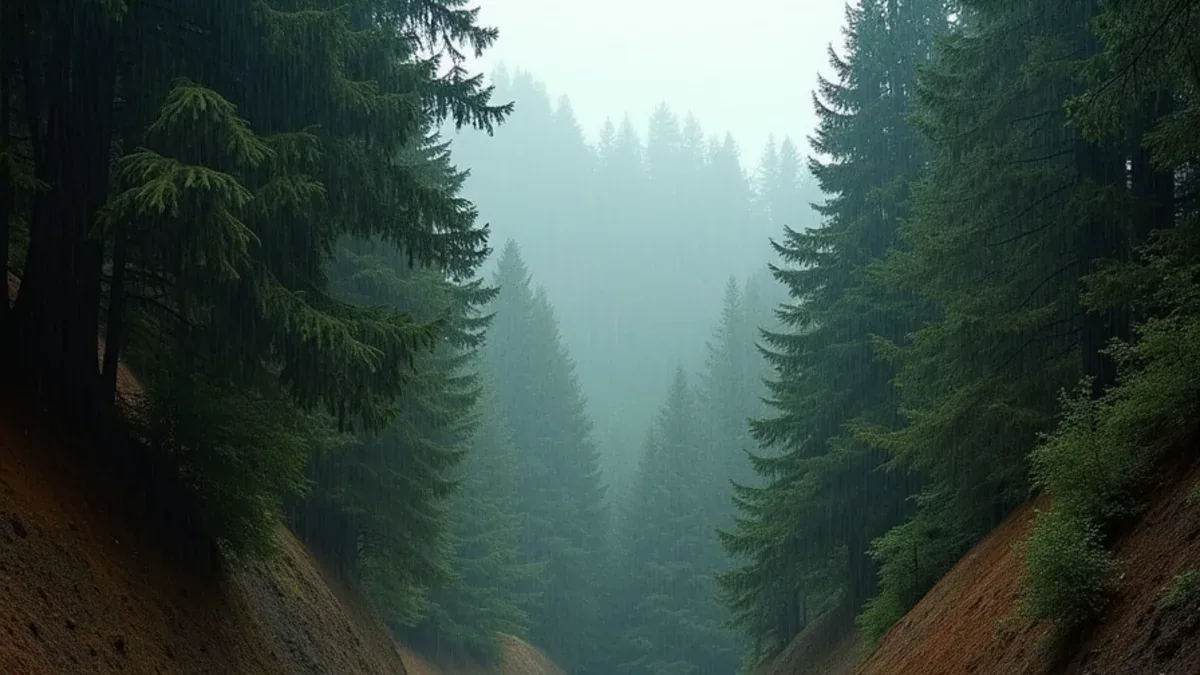
The Canyon Road corridor runs south out of Lafayette toward Moraga through a genuinely narrow canyon. It is about eleven minutes from our base, and during a storm it can be more.
These properties have a risk profile that is different in kind, not just degree, from the rest of Lafayette. Call +1 (201) 277-9344.
Why a canyon bottom is different
On an ordinary hillside lot, water arrives from the slope above you and disperses across the property. In a narrow canyon, the slopes on both sides feed the same low point, and that low point is where the road and the houses are.
The consequence is concentration and speed. Rainfall over a large upslope catchment area converges into a small channel in a short time. A seasonal creek that is a dry gully in September can be running hard within an hour of a serious atmospheric river starting, and it can rise faster than anywhere else in town.
The second consequence is what comes with the water. Canyon flow carries material — leaf litter, branches, soil, gravel, occasionally larger debris off the slopes. That material blocks culverts and channel constrictions, and a blocked culvert turns a manageable flow into water going somewhere it was never meant to go. Nearly every serious canyon flooding event we have attended involved a blockage as much as a volume of water.
Debris flow, and why post-fire matters here more
Debris flow is not the same as flooding. It is a fast-moving slurry of water, soil, rock and vegetation coming off a steep slope, and it carries far more force than water alone. It damages structures rather than just wetting them.
The conditions that produce it are steep slopes, saturated or hydrophobic soil, and intense rainfall — and a canyon concentrates all three. Where a fire has burned on slopes above a canyon, the risk rises sharply for several seasons because burnt ground repels water instead of absorbing it. If a fire burns anywhere upslope of the Canyon Road corridor, the following winter is a materially different situation.
What the cleanup involves
Canyon flooding is Category 3 without exception. The water has crossed open ground, carried soil, vegetation and whatever was on the road surface, and may include sewage if any lateral or main surcharged upstream. See flood cleanup.
- Site safety and slope assessment. Before anyone enters, we look at what is above the property. Saturated slopes move, and a second flow after the first is a genuine risk.
- Pump out and clear solids. Canyon flooding always leaves mud, gravel and vegetation behind. That is shovel work as much as pump work.
- Remove contaminated porous material. Carpet, pad, insulation, drywall cut above the wick line, cabinetry bases. Category 3 means it goes.
- Clean and disinfect every remaining surface with an EPA-registered antimicrobial, with HEPA filtration running.
- Dry to a documented standard, including the crawl space and the subfloor — see structural drying and dehumidification.
- Assess the drainage and the culvert or channel that failed, so the same event does not repeat.
The insurance position, plainly
Surface flooding — including creek overflow and canyon flow — is not covered by a standard California homeowners policy. It requires separate NFIP or private flood insurance. This is the single most important thing for a canyon-bottom property owner to know, and the worst time to discover it is during a claim.
What may be covered is damage caused by a sudden accidental failure of the building during the same event — wind removing roofing, debris breaking a window, a supply line failing. We document the entry path, the source and the timing precisely so a covered element is not denied along with the excluded one.
If your property is in the canyon bottom and you do not have a flood policy, that is worth resolving before December.
Around Canyon Road Area
Streets, roads and landmarks we work around in this area — and the ZIP codes we cover: 94549.
- Canyon Road
- The seasonal canyon creek
- The Moraga corridor
- Steep canyon slopes
- Canyon culverts and crossings
Why Canyon Road Area residents choose us
Every restoration company claims 24/7 and certification. These are the reasons that are specific to working in Canyon Road Area.
Eleven minutes, and more during a storm
We are straight about that. Canyon access is exactly what deteriorates in the conditions that cause the call.
We tell canyon-bottom owners to leave
This is the one place in our service area where the honest advice is evacuation rather than mitigation. Rising canyon water and debris flow move faster than you can react.
We look uphill before anyone enters
Saturated slopes move and a second flow after the first is a genuine risk. Site safety here is a slope assessment, not just an electrical check.
We are blunt about the flood insurance gap
Canyon flow is surface water and excluded from every standard homeowners policy. If you are in the bottom without a flood policy, that is the single most valuable thing we can tell you.
Licensed and insured California contractor · IICRC-certified to the S500 water damage and S520 mold remediation standards · Dispatching to Canyon Road Area from 3450 Golden Gate Way, Lafayette, CA 94549.
You do not need to know what to ask for
Cleanup, extraction, removal, mitigation, restoration — people use all five words for the same job, and nobody expects you to know which one Canyon Road Area needs. Describe what you can see and we will work out the rest.
A local person answers
Not a call center selling your emergency on to whoever bids for it.
First question
Where is the water coming from, and can you get to the shutoff? That decides whether we talk you through it or send someone the 11 minutes to Canyon Road Area first.
Then we move
60-minute dispatch, and we talk you through the shutoff while the crew is loading.
Free, no-obligation inspection with moisture readings and a written assessment. We bill your insurer directly.
Canyon Road Area water damage FAQs
Is canyon flooding covered by homeowners insurance?
No. Surface flooding, including creek overflow and canyon flow, is excluded from a standard California homeowners policy and requires separate NFIP or private flood insurance. What may be covered is damage from a sudden accidental failure of the building during the same event — wind removing roofing, debris breaking a window. We document the entry path and cause precisely so any covered element is not denied along with the excluded one. If you are in the canyon bottom without a flood policy, resolve that before December.
Why does the Canyon Road area flood so fast?
Concentration. Slopes on both sides feed the same low point, so rainfall over a large upslope catchment converges into a small channel in a short time — a gully that is dry in September can be running hard within an hour of a serious atmospheric river starting. The flow also carries leaf litter, branches, soil and gravel, and a blocked culvert turns manageable flow into water going somewhere it was never meant to. Most serious canyon events we attend involved a blockage as much as a volume.
What is debris flow and how is it different from flooding?
Debris flow is a fast-moving slurry of water, soil, rock and vegetation coming off a steep slope. It carries far more force than water alone and damages structures rather than just wetting them. It needs steep slopes, saturated or hydrophobic soil, and intense rain — conditions a canyon concentrates. Where a fire has burned on slopes above, the risk rises sharply for several seasons because burnt ground repels water instead of absorbing it.
Water is rising on Canyon Road right now. What should I do?
Leave. This is the one situation in our service area where the honest advice is evacuation rather than mitigation — rising canyon water and debris flow move faster than you can react, and a single access road can be cut. Do not stay to move belongings or run a pump. Call us when it is over. The restoration will wait and we will be there.
Guides relevant to Canyon Road Area
Standing Water in the House: Is It Safe to Stay, and Who Do You Call First?
Three risks decide this: electrical, contamination and structural. None of them are visible, and two of them will not warn you.
ReadFlood Insurance vs. Homeowners Insurance: Why Storm Flooding Usually Isn't Covered
Almost nobody in Contra Costa County who floods has flood insurance, because almost nobody thinks they need it. The exclusion has nothing to do with whether you are near a creek.
ReadStormwater Got Inside: What's Salvageable After a Flood and What Isn't
One question decides nearly every item: can contaminated water be fully removed from this material, or is it inside it now?
Read