

The Lafayette-Moraga Regional Trail runs on the old rail alignment from near downtown Lafayette south toward Moraga. Properties back onto it along much of its length, and they are about seven minutes from our base.
A trail is a linear corridor with its own grade and its own drainage — and during heavy rain, that has consequences for the houses beside it. Call +1 (201) 277-9344.
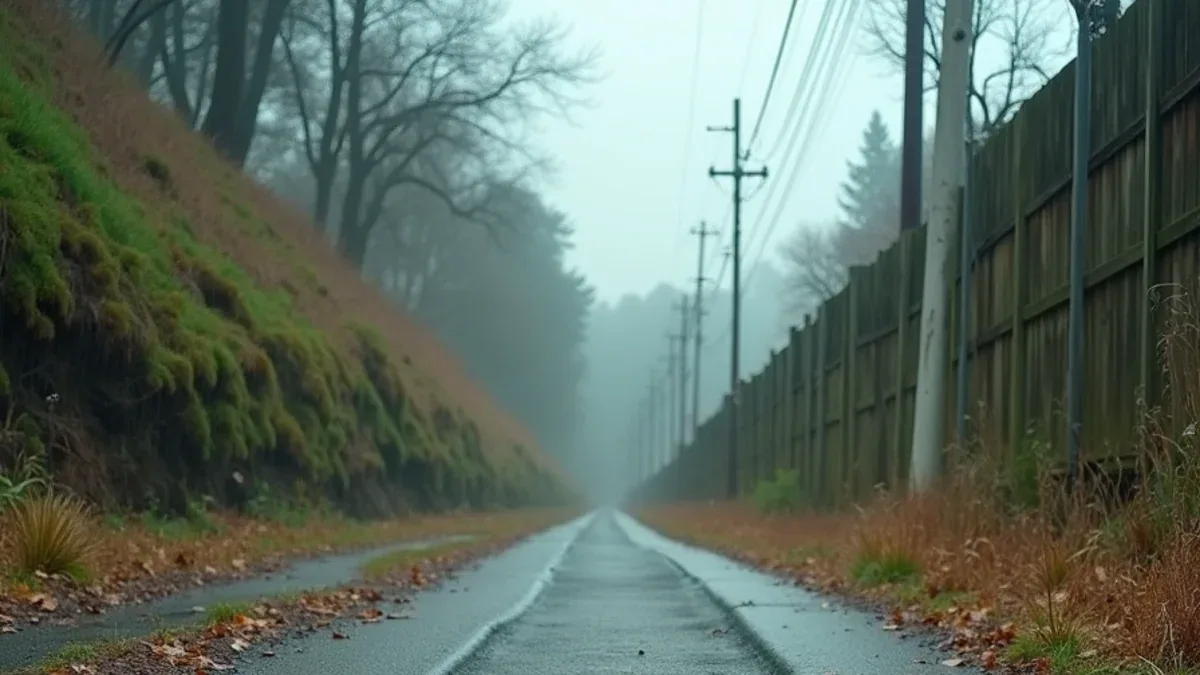
A trail is a drainage channel whether it was meant to be or not
The trail follows a former railway alignment, which means it has a consistent, gentle, engineered grade — exactly the property that makes a good rail bed also makes an efficient water channel.
A paved surface sheds essentially all the rain that lands on it. During an atmospheric river, water runs along the trail surface and along its shoulders, gathering as it goes, until it reaches a low point or a cross drain. If that cross drain, culvert or grate is blocked with leaf litter — and along a wooded corridor it very often is — the water has to go somewhere else. "Somewhere else" is frequently the properties on the downhill side.
This is not a design failure. It is what happens when infrastructure built for one purpose meets rainfall intensities that have increased since it was built, plus a maintenance cycle that cannot clear every grate before every storm.
How it presents on a trail-adjacent property
- Water arriving at the back fence line during heavy rain and spreading across the rear garden, rather than falling on it evenly.
- Persistent saturation in a strip of the garden nearest the trail, long after the rest has drained.
- Water entering a crawl space through rear foundation vents, which is usually the first structural consequence. See flooded basement and crawl space cleanup.
- Intrusion at a rear slider or lower-level door on properties where the trail sits above the house.
- Fence posts and rear retaining structures rotting or moving from chronic saturation.
- A wet or musty crawl space with no plumbing cause anywhere in the house.
What you can actually do about it
You cannot maintain the trail — that is the East Bay Regional Park District's and the relevant agency's responsibility, and reporting a blocked culvert or grate to them is genuinely worth doing, particularly before the season starts.
What you can do is manage what reaches your building:
- Establish an interception swale or French drain inside your boundary on the trail side, discharging to a safe outfall. This is the single most effective intervention.
- Regrade the strip nearest the trail so it falls away from the house rather than toward it.
- Keep rear foundation vents clear and consider well-covers or raised vent details where water reaches them.
- Extend downspouts so roof water is not adding to whatever is already arriving from behind.
- Photograph and date what happens during storms. If water is arriving from public land, a record of it matters — both for any conversation with the agency and for your own documentation.
The houses along the trail
The trail runs past a range of Lafayette housing — mid-century ranches, later custom builds, and pockets of newer infill — on generally larger lots with wooded edges. Beyond the drainage issue, the standard local pattern applies: mid-century plumbing at pinhole age, garage water heaters, and mature trees pressing on sewer laterals. See burst pipe cleanup and sewage cleanup.
The trail corridor continues into Moraga and passes near Burton Valley and Oak Hill Road, where the same drainage considerations apply.
Around Lafayette-Moraga Trail Area
Streets, roads and landmarks we work around in this area — and the ZIP codes we cover: 94549.
- Lafayette-Moraga Regional Trail
- Olympic Boulevard trail head
- St Mary's Road
- The former rail alignment
- Trail cross culverts
Why Lafayette-Moraga Trail Area residents choose us
Every restoration company claims 24/7 and certification. These are the reasons that are specific to working in Lafayette-Moraga Trail Area.
Seven minutes to the corridor
The trail runs the length of the old rail alignment, so we know the access points along it.
We understand the trail is a drainage channel
A paved surface on an engineered rail grade sheds all its rain and gathers it along the shoulders. Where a cross culvert blocks with leaf litter, it exits onto the properties downhill.
We check the rear foundation vents first
Trail runoff enters through them long before anything shows indoors. Looking there during the storm tells you exactly where an interception drain needs to go.
We document flow arriving from public land
Dated photographs of a blocked culvert and the flow path matter — for the report to the park district, and if it ever becomes a question of responsibility.
Licensed and insured California contractor · IICRC-certified to the S500 water damage and S520 mold remediation standards · Dispatching to Lafayette-Moraga Trail Area from 3450 Golden Gate Way, Lafayette, CA 94549.
You do not need to know what to ask for
Cleanup, extraction, removal, mitigation, restoration — people use all five words for the same job, and nobody expects you to know which one Lafayette-Moraga Trail Area needs. Describe what you can see and we will work out the rest.
A local person answers
Not a call center selling your emergency on to whoever bids for it.
First question
Where is the water coming from, and can you get to the shutoff? That decides whether we talk you through it or send someone the 7 minutes to Lafayette-Moraga Trail Area first.
Then we move
60-minute dispatch, and we talk you through the shutoff while the crew is loading.
Free, no-obligation inspection with moisture readings and a written assessment. We bill your insurer directly.
Lafayette-Moraga Trail Area water damage FAQs
Can the Lafayette-Moraga Trail really cause water to come onto my property?
Yes, and it is a recurring pattern along the corridor. The trail follows a former rail alignment with a consistent engineered grade, and a paved surface sheds essentially all the rain that lands on it. Water runs along the trail and its shoulders, gathering as it goes, until it reaches a cross drain — and if that culvert or grate is blocked with leaf litter, which along a wooded corridor it often is, the water goes onto the properties on the downhill side instead.
What can I do if water is coming off the Lafayette-Moraga Trail?
Two tracks. Report blocked culverts and grates to the park district before the season starts, and photograph them with a date. Then manage what reaches your building: an interception swale or French drain inside your boundary on the trail side discharging to a safe outfall is the single most effective intervention, plus regrading the strip nearest the trail to fall away from the house and keeping rear foundation vents clear.
My crawl space gets wet every winter but there is no plumbing leak.
On a trail-adjacent property that is very often exterior water entering through rear foundation vents. It is the first structural consequence of trail runoff and it is easy to miss because nobody goes into a crawl space. Open the hatch and look with a torch during or right after a heavy storm — you will see whether water is coming in, and roughly from where. That tells you exactly where the interception drain needs to go.
Does this affect the Moraga end of the trail too?
The same mechanism applies along the whole corridor wherever properties sit downhill of the trail alignment and a cross drain can block. The specifics vary with local grade — some stretches drain freely and some concentrate water at particular low points. If your property backs onto the trail anywhere along its length, watching what happens during the first serious storm of the season is the most useful thing you can do.
Guides relevant to Lafayette-Moraga Trail Area
Wet Drywall: When It Can Be Saved and When It Has to Come Out
Plenty of drywall that gets cut out could have been dried in place. Plenty that gets left should have come off. Four questions decide it.
ReadThe Lafayette-Moraga Regional Trail: How Adjacent Homes Can Experience Water Intrusion From Trail Drainage
A rail trail is a paved corridor with an engineered grade. Everything that makes it pleasant to cycle on also makes it an efficient water channel.
Read