
The short answer
Shut the water off first — fixture valve, then water heater inlet, then house main, then the meter at the street. Then kill power to wet areas at the breaker, photograph everything before you move it, and get extraction started. A half-inch line at household pressure loses several gallons a minute.
The single variable you control in a burst pipe is time. Not the damage that already happened — the damage that is happening while you decide what to do. A half-inch copper supply line at typical household pressure discharges several gallons a minute. Twenty minutes unnoticed is a hundred gallons through your framing and down to the floor below.
Here is the sequence, in order. Do what you can do safely. Skip anything that puts you in standing water near electricity.
Minute 1 to 5: shut off the water
Everything else is secondary. Work through these in order and stop at the first one that works.
- The fixture shutoff. A small oval or lever valve behind the toilet, under the sink, or behind the washing machine. Turn clockwise until it stops. If the burst is downstream of that valve, you are done in ten seconds.
- The water heater cold inlet valve, on top of the tank. Isolates the entire hot side of the house.
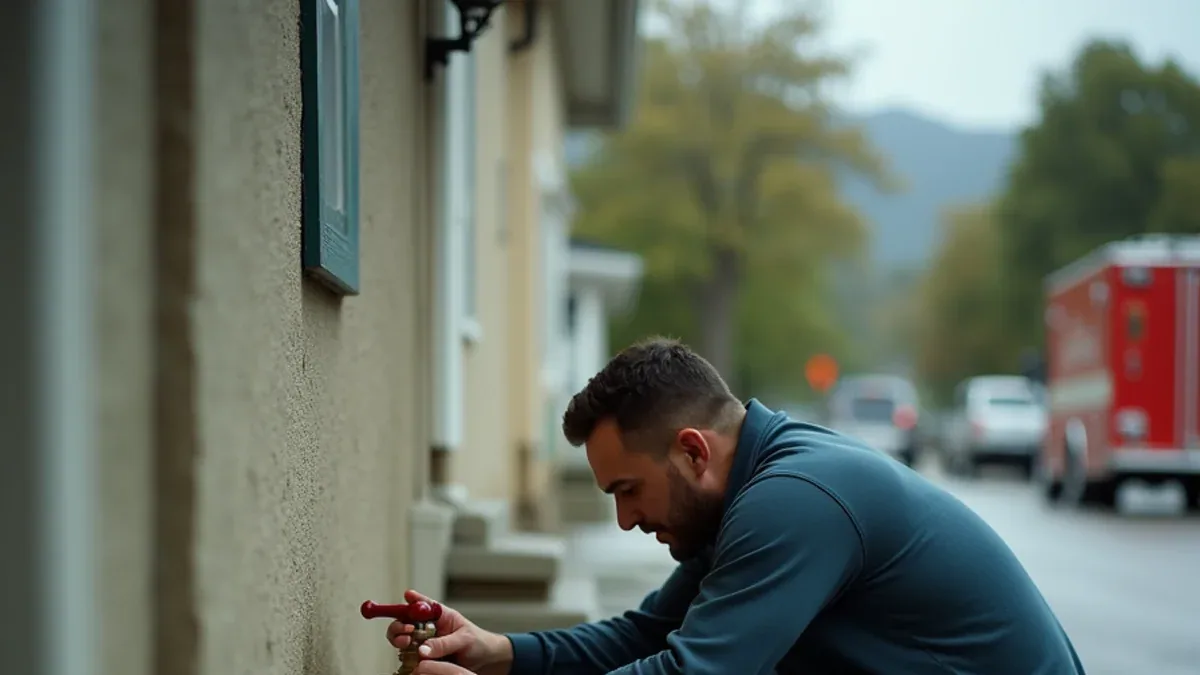
- The house main. Usually on the exterior wall closest to the street, frequently near the hose bib on that side, sometimes inside the garage on the street-side wall. A lever handle turns ninety degrees; a round handle turns clockwise several full turns.
- The meter valve at the street. In a concrete or plastic box at the property line near the sidewalk. The valve sits beside the meter and needs a meter key or a large adjustable wrench — turn the flat tab so it lies crosswise to the pipe. This always works.
Minute 5 to 10: kill the power if water is near it
If water is anywhere near outlets, extension cords, a plugged-in appliance or a light fixture, switch off the affected circuits at the breaker panel. Water pools inside recessed light cans and energizes them.
Never stand in water to reach a panel. If the panel itself is in the wet area, or if you are unsure, leave it and call the fire department. Nobody has ever regretted being cautious about this.
Minute 10 to 20: photograph everything before you move anything
This is the highest-value twenty minutes of your entire insurance claim, and almost everybody skips it because they want to start mopping.
- Wide shots of every affected room, from the doorway, before anything is moved.
- The source itself — the split pipe, the failed connector, the burst hose. A burst pipe claim turns on showing the failure was sudden and accidental, and a photograph of the actual split is the best evidence there is.
- The water line on the wall and on any furniture, with something for scale.
- Every wet item, individually, before it is moved to a dry room.
- Video walking the whole affected area, narrating what you are seeing and the time.
Do this on your phone. Do not worry about quality. Volume and timing matter more than composition.
Minute 20 to 40: limit the spread
Now you can start moving things, and the priority is preventing secondary damage rather than removing water.
- Lift furniture legs onto blocks, foil squares or plastic tubs. Wooden furniture legs on wet carpet bleed stain into the fiber within hours, and that stain does not come out.
- Roll rugs and get them out. Especially anything with dye that runs. Wool and hand-knotted rugs go to a specialist, not into a dry corner.
- Move electronics, documents and photographs to a dry room. Do not power on anything that got wet.
- Open cabinet doors and drawers in affected kitchens and bathrooms so air can reach inside.
- Do not run the HVAC if a return or supply register sits in the affected area.
Minute 40 to 60: make two phone calls
Your insurance carrier. Open the claim and get a claim number. You do not need to know the cost or the scope. What matters is that the loss is on record with today's date — a delay of days is one of the easiest things for a carrier to push back on.
A restoration contractor, for extraction and drying. Call us at +1 (201) 277-9344 — we answer 24 hours and we will talk you through anything on this list you have not managed while a crew is dispatched. See burst pipe cleanup for what happens next.
You will also need a plumber for the pipe repair itself. We coordinate that so the wall is opened once rather than three times.
What happens if you wait until morning
People ask this constantly at 1 a.m., and the honest answer is that overnight is a substantial fraction of the 24 to 48 hour window in which mold can begin growing on wet building materials under EPA and IICRC guidance.
More practically: water spreads for every hour it sits. The difference between extracting at midnight and extracting at nine is frequently another room of flooring, another two days of drying equipment, and the difference between saving a hardwood floor and replacing it. The after-hours call-out rate is small next to that.
Do this on a dry Saturday instead
The homeowners who handle a burst pipe well are the ones who found the shutoff before they needed it.
Fifteen minutes that will save you thousands
- Find your main shutoff. Turn it off, then on, to confirm it is not seized.
- Photograph it and text the photo to everyone in the household.
- Locate the meter box at the street and check you can lift the lid.
- Buy a meter key. They cost very little and live in the garage.
- Replace the braided supply connectors under every sink and behind every toilet — they have a five to ten year service life and they are the most common failure in any house.
- Put a pressure gauge on an outdoor hose bib. Over 80 psi means the regulator needs attention.
This matters more in some neighborhoods than others. Across the 1960s and 1970s hillside tracts in Burton Valley and the rest of Lafayette, original copper is squarely at pinhole age — which means the first burst is rarely the last.
Frequently asked
Where is the main water shutoff in most houses?
Usually on the exterior wall closest to the street, often near the hose bib on that side, and sometimes inside the garage on the street-side wall. If you cannot find it, the meter valve at the property line always works — it is in a concrete or plastic box near the sidewalk, beside the meter, and needs a meter key or a large adjustable wrench to turn the flat tab crosswise to the pipe.
Should I try to patch the pipe myself?
Not as a first move. Shut the water off, document the failure, and get a plumber. A temporary clamp or tape repair on a pressurized line can hold or can fail again at a worse moment, and if you cover the split before photographing it you have lost the best evidence your insurance claim has. Get the water off, get the pictures, then get the proper repair.
Is a burst pipe covered by insurance?
Generally yes. Sudden and accidental discharge from a plumbing system is exactly what a standard California homeowners policy covers, including the resulting damage to flooring, drywall, cabinetry and contents plus the drying costs. The repair of the pipe itself is typically not covered, and damage a carrier can characterize as long-term seepage rather than a sudden failure is often excluded — which is why photographing the split section matters.
How fast does mold start after a burst pipe?
Under EPA and IICRC guidance, mold can begin growing on wet building materials within 24 to 48 hours. Warm, enclosed, unventilated spaces — a wall cavity, under floating flooring, a crawl space — are fastest, because the moisture has nowhere to go. That window is the entire reason emergency extraction and monitored drying are urgent rather than optional.