
The short answer
Close the cold inlet valve on top of the tank, switch off the gas or the breaker, then move anything still dry off the floor. Do not open the drain valve into standing water. The garage is rarely the whole problem — the shared bottom plate wicks water into the adjoining room.
When a water heater tank corrodes through, it releases its 40 to 80 gallons across the floor and then keeps going. The fill valve does what it is designed to do: it senses the level dropping and refills. Which is why a failure at 2 a.m. can put several hundred gallons through a garage by morning.
Shutting it down properly takes about ninety seconds if you know the order.
Step 1: close the cold water inlet
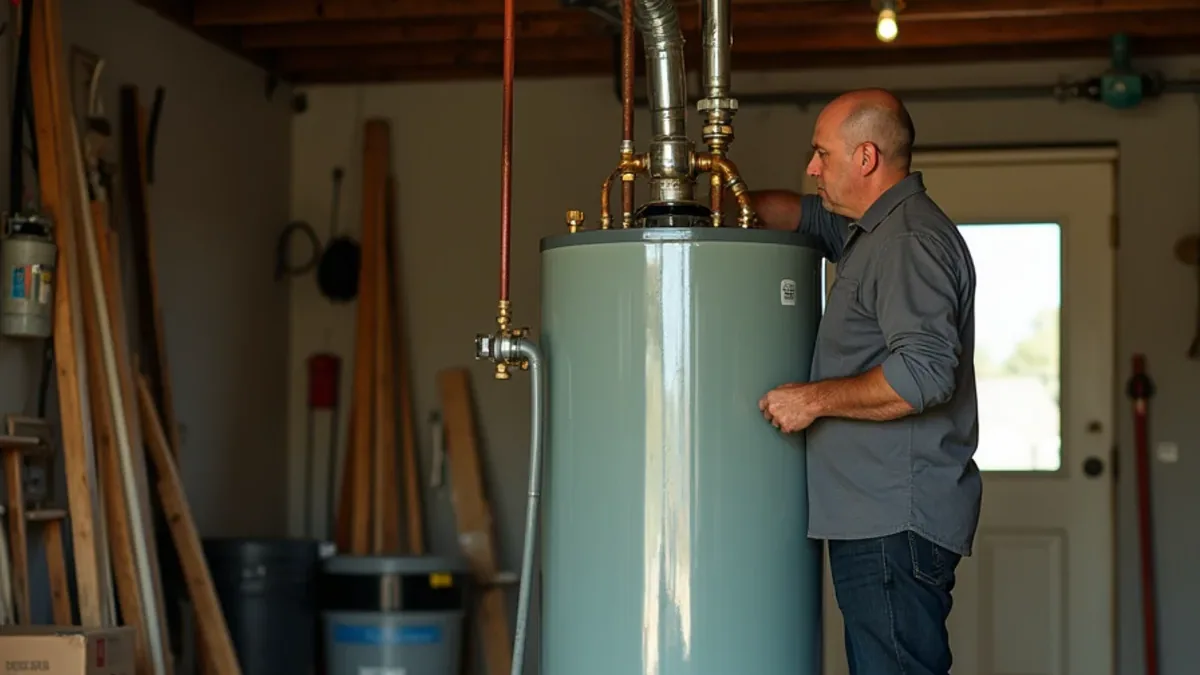
Look at the two pipes entering the top of the tank. One of them — usually with a lever or gate valve on it a short way above the tank — is the cold inlet. Close it. Lever valves turn ninety degrees; gate valves turn clockwise several turns.
This stops the refill, which stops the flood from growing. If the valve is seized or missing, go to the house main — normally on the exterior wall closest to the street — or to the meter valve at the property line.
Step 2: kill the energy source
Gas heater: turn the control knob on the front of the unit to OFF. If you smell gas at any point, do not touch switches, leave the building, and call PG&E from outside.
Electric heater: switch off the water heater breaker at the panel. An electric element that keeps firing in an emptying tank burns out, and there is a live circuit next to standing water.
Step 3: cut power to anything in the water
Garages have outlets at floor level, extension cords, chest freezers, second refrigerators and washer-dryer sets. If water has reached any of them, switch those circuits off at the panel. Do not walk through standing water to reach the panel.
Step 4: photograph before you move anything
The tank itself, the failure point, the water spread across the slab, the wet base of every stored item, and the wall the water reached. Wide shots first, then close.
A sudden tank failure is a textbook covered loss under a standard California homeowners policy — the resulting damage, not the tank replacement itself. Photographs of the tank with water coming from the base rather than from a fitting are what establishes that it was sudden rather than a seep you had been ignoring.
Step 5: check the wall — this is the part people miss
Here is the single most common mistake we see on garage floods, and it is expensive.
A garage slab is usually poured slightly lower than the house floor, so people assume the water stayed in the garage. But the bottom plate of the shared wall is porous timber, and water wicks straight through it into whatever is on the other side — most often a hallway, a laundry room or a bedroom closet.
Go inside and check the flooring along every wall that backs onto the garage. Press down on the carpet, feel the base of the baseboard, and look inside any closet on that wall. If the garage looked like the whole problem, that is exactly the job that becomes a mold call in three months.
The drywall on the garage side wicks upward too, typically six to twelve inches, which is why it usually has to come off rather than be left to dry.
Step 6: get the cardboard off the floor
Almost everything stored in a garage is in cardboard, and wet cardboard is both a total loss and an excellent mold substrate. Get boxes up onto a workbench or out onto a dry driveway, and open them to see what is actually damaged. Photographs, documents and anything paper are time-critical — tell your restoration contractor on the first call if there is anything irreplaceable, because specialist freeze-drying can recover a great deal but only before mold establishes.
What we do when we get there
Extraction across the whole slab including the low corners water always finds, moisture mapping every shared wall and the rooms beyond, contents triage and documentation, removal of the wicked drywall and any saturated insulation, then drying. Concrete gives moisture back slowly, so garage drying runs longer than people expect. See water heater leak cleanup.
While the plumber is there: three things worth adding
- A drain pan under the new tank, piped to a drain or to the exterior. It turns a flood into a puddle and costs very little at installation time.
- A floor-level water alarm beside the tank. Under $20, and it is the difference between finding this at hour one and hour eight.
- Correct seismic strapping. California Health and Safety Code §19211 requires two straps — upper third and lower third, with the lower one at least four inches above the controls. We see single straps and plumbers tape constantly, and neither meets it.
And know the age of your tank. The manufacture date is encoded in the serial number on the label. A conventional heater lasts 8 to 12 years — replacing at year eleven on your schedule costs a fraction of replacing at thirteen on its own. This is a particularly common call across the older housing in De La Fuente and the rest of mid-century Lafayette.
Frequently asked
Can a water heater that has been flooded be repaired?
Usually not, and this is different from a heater that is merely leaking. If flood water reached the gas control valve and burner assembly, manufacturers are unanimous that those parts are replaced rather than dried — a submerged control can corrode internally and fail in ways you cannot see from outside, which is the one failure mode nobody wants on a gas appliance. On an electric unit the same applies to submerged thermostats and elements. Once the parts and the labor are added up, replacing the heater is usually the cheaper answer anyway.
What happens if a water heater gets wet on the outside?
Splashes on the jacket are not the problem. What matters is whether water got *inside* — into the burner compartment at the base of a gas unit, or behind the access panels on an electric one — and whether it reached the insulation inside the jacket. Wet jacket insulation does not dry out in service; it holds moisture against the tank and accelerates external corrosion. If the water line on the wall was above the burner compartment, treat it as flooded rather than splashed.
Can a leaking water heater be repaired instead of replaced?
It depends where it leaks. A drip at a threaded inlet or outlet fitting, or at the drain valve, is usually repairable. Water seeping from the base of the tank with no visible fitting leak means the steel shell has corroded through, and that is not repairable at any price — the tank has to be replaced, and quickly, because shell failures progress to full release without much warning.
Does insurance cover a water heater flood?
The resulting water damage from a sudden tank failure is generally covered under a standard California homeowners policy — that is textbook sudden and accidental discharge. The replacement of the water heater itself is generally not, because that is the failed appliance rather than the damage it caused. A tank that has been visibly seeping for months is a harder claim, so document the failure and the timeline honestly.
How do I know if water got into the house from the garage?
Check the flooring along every wall that backs onto the garage. Press on the carpet, feel the base of the baseboard, and look inside any closet on that wall. The garage slab is usually lower than the house floor, but the bottom plate of the shared wall is porous timber and water wicks straight through it. A moisture meter settles it definitively, and any restoration contractor should be checking this as standard.
How old is too old for a water heater?
A conventional tank runs 8 to 12 years, and the moderately hard water in this county does not extend that. The manufacture date is encoded in the serial number on the label — most manufacturers put the year and week in the first four characters. Over ten years, replacing on your schedule costs a fraction of replacing on the tank's schedule with a flooded garage and a wet hallway.