

A 50-gallon tank does not leak politely. When the tank itself corrodes through, it empties across the floor and then keeps refilling and emptying until someone shuts the cold inlet off — which is why a failure at 2 a.m. can put several hundred gallons through a garage and under the wall into the house.
In Lafayette that garage is almost always attached, and it usually shares a wall with a hallway, a laundry or a bedroom. Call +1 (201) 277-9344.
Signs you need water heater leak cleanup
If you recognize two or more of these, the problem is already past the point where waiting is cheaper.
Water pooling at the base of the tank
If it is not a fitting, it is the shell. The tank is finished — replace it, do not repair it.
Rusty or discoloured hot water
Interior corrosion and a spent anode rod. The tank is in its last phase.
Rumbling or popping while heating
Sediment on the tank floor. Reduces efficiency and accelerates shell failure.
Discharge from the T&P relief pipe
Over-temperature or over-pressure. A safety issue, not a nuisance.
Damp or stained drywall on the shared garage wall
Water has already gone under the plate into the house side.
A tank over ten years old
Beyond typical service life. Replace on your schedule rather than its own.
Shut it down in the right order
- Close the cold water inlet valve on top of the tank — the one on the pipe coming in, usually a lever or a gate valve. This stops the refill. If it will not turn, go to the house main.
- Kill the energy source. Gas: turn the control knob to OFF, and if you smell gas at all, leave the building and call PG&E from outside. Electric: switch the water heater breaker off at the panel.
- Do not open the drain valve to empty it unless you have a hose run somewhere sensible. You will simply move the water.
- Get power off to any circuit with outlets or appliances in the standing water.
- Photograph everything — the tank, the failure point, the water spread, the wet wall base.
- Call us, and call a plumber for the replacement tank.
Why the garage is the worst place for this to happen
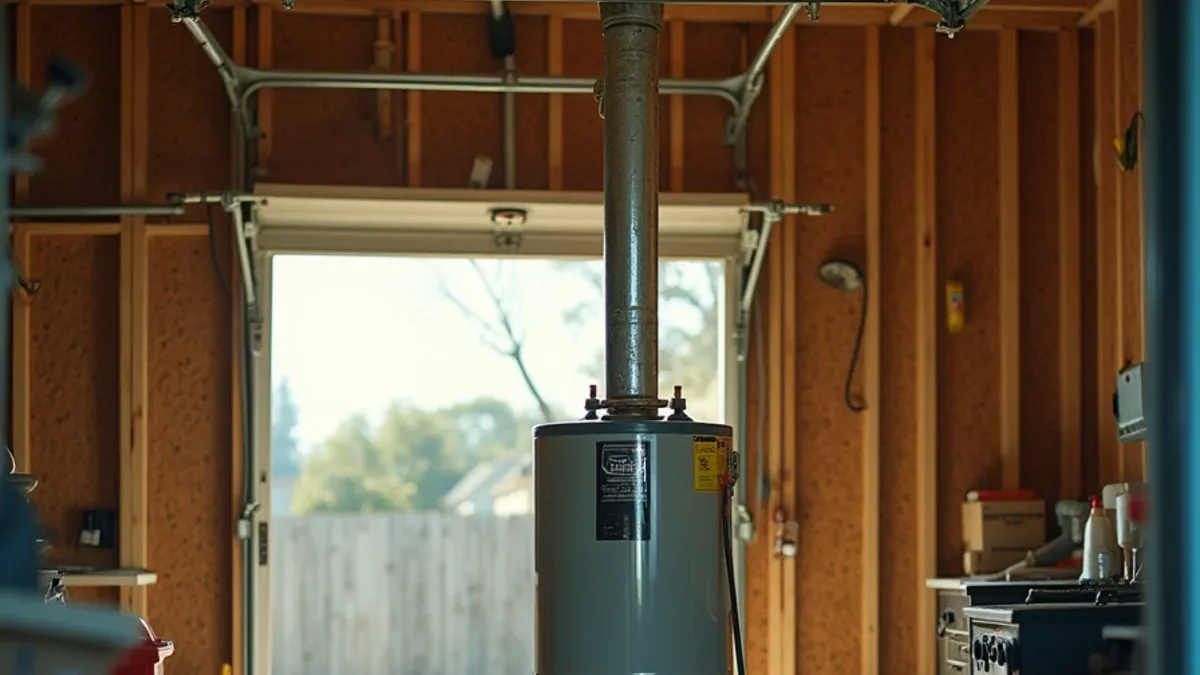
Nearly every Lafayette home built from the 1950s on puts the water heater in the attached garage. It makes sense for venting and for space, and it means a failure floods the one room where nobody notices for hours.
The specific problems we deal with, in order of how often they surprise people:
- Water crosses under the shared wall. A garage slab is usually poured slightly lower than the house floor, but the bottom plate of the shared wall is porous and water wicks straight through it into the hallway carpet or the laundry room. The garage looks like the whole problem; it is rarely the whole problem.
- Drywall wicks upward. The garage side of that wall is drywall on the bottom plate, and it draws water up six to twelve inches. It needs to come off, not be left to "dry out".
- Everything on the floor is cardboard. Stored boxes, holiday decorations, paperwork, photographs. Wet cardboard is both a total loss and a mold substrate.
- Appliances sit directly on the slab. Chest freezers, second refrigerators and washer/dryer sets all have components at floor level.
- Garage insulation and finished ceilings above hold water and hide it.
California water heater strapping law
California Health and Safety Code §19211 requires water heaters to be braced, anchored or strapped to resist horizontal displacement from earthquake motion. The standard practice is two straps — one in the upper third of the tank and one in the lower third, with the lower one at least four inches above the controls.
We mention it on this page because we see it wrong constantly: a single strap, straps that are loose, plumbers tape instead of proper strapping, or nothing at all. A 50-gallon tank full of water weighs around 200 kilograms and it sits on a narrow base. In a significant Bay Area earthquake, an unstrapped tank tips, tears the supply and gas connections off, and you have a flood and a gas leak simultaneously.
It is also a disclosure item on a California property transfer. If you are selling, it will come up.
How tanks fail, and how long you have
| Failure | What you see | Typical timeline |
|---|---|---|
| Tank corrosion through the shell | Water seeping from the base with no visible fitting leak | Catastrophic — the tank is finished, replace immediately |
| T&P relief valve discharge | Hot water or steam from the discharge pipe | Safety issue now — shut down and call a plumber |
| Drain valve seep | A slow drip from the plastic or brass valve at the base | Repairable, but do it now — it will not improve |
| Inlet or outlet fitting leak | A drip at a threaded connection on top of the tank | Repairable, often just needs remaking |
| Failed anode rod, accelerating corrosion | Rusty hot water, sometimes a rotten-egg smell | Warning sign — the tank is on borrowed time |
| Sediment buildup | Rumbling or popping sounds when heating | Reduces efficiency and accelerates shell corrosion |
A conventional tank has a service life of roughly 8 to 12 years, and this county has moderately hard water that does not extend it. If yours is over ten and you do not know its age, the manufacture date is encoded in the serial number on the label. Replacing a tank at year eleven on your schedule costs a fraction of replacing it at year thirteen on its schedule with a garage full of water.
Our cleanup
Confirm shutdown and extract
Water and energy off, then extraction across the garage slab and anywhere it traveled. Slabs look flat and never are — water always finds a low corner.
Follow it under the wall
Moisture mapping on the house side of every shared wall. This is the step that gets skipped, and it is the one that produces a mold call three months later.
Contents triage
Everything off the floor. Wet cardboard out, salvageable hard goods cleaned and set aside, anything of value inventoried and documented for the claim.
Remove wet material
Garage drywall cut above the wick line, saturated insulation out, and affected carpet and pad on the house side removed.
Dry the slab and the assemblies
Concrete gives moisture back slowly, so garage drying runs longer than people expect. Air movers, dehumidification and daily readings — see structural drying and dehumidification.
Reinstate
Drywall, paint, and any flooring on the house side. We coordinate with your plumber so the new tank goes in before the wall closes up.
This is a common call across the older housing stock in De La Fuente, Springhill and the Golden Gate Way corridor, and it is by some distance the most frequent loss we attend in Rossmoor, where a very large number of original appliances hit replacement age within a few years of each other.
You do not need to know what to ask for
You do not have to know whether this is water heater leak cleanup, extraction, mitigation or a full restoration — those are stages of one job and sorting out which you need is our work, not yours.
A local person answers
Not a call center selling your emergency on to whoever bids for it.
First question
Has the water stopped? Everything about water heater leak cleanup changes depending on whether it is still arriving.
Then we move
60-minute dispatch, and we talk you through the shutoff while the crew is loading.
Free, no-obligation inspection with moisture readings and a written assessment. We bill your insurer directly.
Our water heater leak cleanup process
Six steps, documented at every stage, with the daily readings that prove it.
Shut down safely
Cold inlet closed, gas or breaker off, affected circuits isolated.
Extract the garage
Full slab extraction including the low corners water always finds.
Trace it into the house
Moisture mapping every shared wall and the rooms beyond.
Triage contents
Wet cardboard out, salvageable goods cleaned, everything documented.
Remove and dry
Wicked drywall and insulation out, slab and assemblies dried with daily readings.
Reinstate and improve
Rebuild, plus a drain pan and a floor water alarm with the new tank.
What drives the price
We are not going to quote a number over the phone — nobody can scope a water loss without walking the property. These are the factors that decide it.
- Whether the water reached the living space
- A contained garage slab is straightforward. Carpet, subfloor and drywall on the house side is a much larger scope.
- Volume released
- A slow seep caught early versus a full tank plus continued refill overnight are entirely different jobs.
- Contents affected
- A full garage of stored boxes takes real time to triage, document and dispose of.
- Slab drying duration
- Concrete is slow. Garage drying commonly runs longer than a comparable carpeted room.
- Drywall and insulation removal
- Linear feet of wall base to cut, and whether the garage ceiling is finished and insulated.
- Plumbing replacement
- The new tank, the pan, the expansion tank and correct seismic strapping are separate plumbing costs.
Why choose Water Lafayette for water heater leak cleanup
Not the generic badges every restoration site carries — the things that actually change the outcome on this particular job.
We moisture-map every shared wall as standard
Garage slabs sit lower than the house floor, but the shared wall bottom plate is porous and wicks straight through. The job where the garage looked like the whole problem is the one that becomes a mold call.
Shutdown talked through in the right order
Cold inlet, then gas control or breaker, then affected circuits. Doing it in the wrong order on a gas heater is how people end up with a dry-fired tank on top of a flood.
We check the strapping against §19211
Two straps, upper and lower third, lower one at least four inches above the controls, anchored into studs. We see single straps and plumbers tape constantly, and neither meets the code.
Contents triaged, not bagged wholesale
Wet cardboard goes. Hard goods get cleaned and inventoried. Anything paper or photographic is flagged as time-critical before mold establishes.
We tell your plumber to add a pan and an alarm
A drain pan piped to the exterior turns the next flood into a puddle, and a floor alarm costs under twenty dollars. Both together are less than an hour of our labor.
Licensed and insured California contractor · IICRC-certified to the S500 water damage and S520 mold remediation standards · 60-minute dispatch across Lafayette and Lamorinda · Based at 3450 Golden Gate Way, Lafayette, CA 94549.
Water Heater Leak Cleanup FAQs
My water heater is leaking. Do I need a new one or can it be repaired?
It depends on where it leaks. A drip at a threaded inlet or outlet fitting, or at the drain valve, is usually repairable. Water seeping from the base of the tank with no visible fitting leak means the steel shell has corroded through, and that is not repairable at any price — the tank has to be replaced, and quickly, because shell failures progress to full release without much warning.
How long does a water heater last?
A conventional tank runs roughly 8 to 12 years, and the moderately hard water in this county does not extend that. If you do not know the age, the manufacture date is encoded in the serial number on the label. Replacing at year eleven on your schedule costs a fraction of replacing at year thirteen on the tank's schedule with a garage full of water and a wet hallway.
Is water heater damage covered by homeowners insurance?
The resulting water damage from a sudden tank failure is generally covered under a standard California homeowners policy — that is textbook sudden and accidental discharge. The replacement of the water heater itself is generally not covered, because that is the failed appliance rather than the damage it caused. A tank that has been visibly seeping for months is a harder claim, so document the failure and the timeline honestly.
Does the water heater have to be strapped in California?
Yes. California Health and Safety Code §19211 requires water heaters to be braced, anchored or strapped against horizontal displacement in an earthquake. Standard practice is two straps, one in the upper third of the tank and one in the lower third at least four inches above the controls. A full 50-gallon tank weighs around 200 kilograms on a narrow base — unstrapped, it tips in a significant quake and tears off both the water and the gas connections. It is also a disclosure item when you sell.
The garage flooded but the house seems dry. Am I fine?
Check before you assume. Garage slabs are typically poured slightly lower than the house floor, but the bottom plate of the shared wall is porous and water wicks straight through it into whatever is on the other side — usually a hallway, a laundry or a bedroom closet. We moisture-map every shared wall and the rooms beyond as standard, because the garage-looked-like-the-whole-problem job is the one that turns into a mold call three months later.
Related reading
Water Heater Flooded the Garage: Emergency Steps Before Help Arrives
A failed tank does not just empty — it keeps refilling and emptying until someone closes the inlet. Here is the shutdown order, and the wall almost everybody forgets to check.
ReadCalifornia's Water Heater Strapping Law (HSC §19211): The Earthquake Leak Risk Hiding in Your Garage
A full 50-gallon tank weighs around 200 kilograms and stands on a narrow base. Two straps are the difference between a quake you clean up after and one that also floods and gasses the house.
Read