
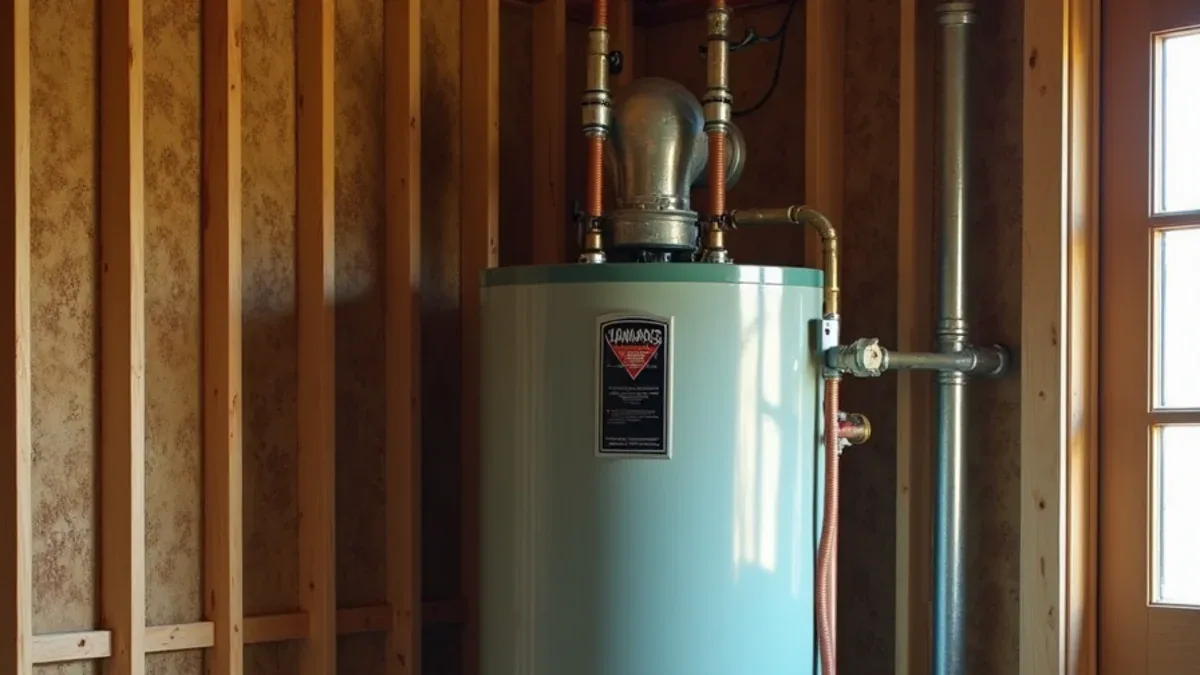
The short answer
California Health and Safety Code §19211 requires every water heater to be braced against earthquake movement. In practice that means two straps, one in the upper third and one in the lower third at least four inches above the controls, anchored into studs. An unstrapped tank shears its supply lines.
California Health and Safety Code §19211 requires water heaters to be braced, anchored or strapped to resist horizontal displacement from earthquake motion. It has been in force for decades and it is one of the more consequential small requirements in the code.
It is also, in our experience, one of the most frequently done wrong.
What the requirement actually is
The standard practice that satisfies it is straightforward:
- Two straps, not one.
- The upper strap in the top third of the tank.
- The lower strap in the bottom third, positioned at least four inches above the controls — the thermostat and gas control on a gas heater.
- Anchored into structure — wall studs or masonry — not into drywall alone.
- Proper metal strapping, correctly tensioned. Plumbers tape and improvised alternatives do not satisfy the requirement.
- Flexible water connectors at the tank, so movement does not shear the rigid pipe.
- On a gas heater, a flexible gas connector for the same reason.
What we actually find
On the water heater jobs we attend across Lafayette, Moraga, Orinda and the wider county, the recurring problems are:
- A single strap, usually around the middle. A single strap allows the tank to rotate about it.
- Loose straps that have slackened over years, so the tank can move before the strap engages.
- Plumbers tape — perforated metal banding — instead of proper strapping. It is not rated for this and it tears.
- Straps anchored into drywall rather than into studs. The strap holds; the drywall does not.
- The lower strap too low, across the controls rather than above them.
- Nothing at all, particularly on older installations that predate enforcement.
It is worth going and looking at yours right now. It takes thirty seconds and you will know immediately.
Why it matters — the actual failure mode
A full 50-gallon tank weighs roughly 200 kilograms, and it stands on a comparatively narrow circular base with a high center of gravity. In seismic ground motion it wants to rock and topple.
When it does, three things happen at once:
The water connections shear. Rigid copper connections snap at the tank. Now the supply line is open and discharging at full mains pressure into the garage — and it keeps discharging until someone finds the shutoff.
On a gas heater, the gas connection shears. A rigid gas line breaking at a toppled appliance is a serious hazard in a building that has just experienced an earthquake, potentially alongside other damage and with emergency services fully committed elsewhere.
The flue disconnects. Combustion products no longer vent outside.
That is the scenario the code section exists to prevent, and two straps and two flexible connectors are the whole intervention.
It is also a disclosure item
California residential property transfer disclosure requires the seller to state whether the water heater is braced, anchored or strapped in compliance with §19211. If you are selling, it will come up, and it is a trivially small item to correct beforehand.
The everyday risk is bigger than the earthquake risk
To be straight about it: most Lafayette homeowners will never experience a quake severe enough to topple a strapped tank. What they are much more likely to experience is the tank simply corroding through and emptying across the garage.
That is a routine call for us, and the part people miss is that a garage slab is usually poured slightly lower than the house floor but the bottom plate of the shared wall is porous timber — water wicks straight through it into the hallway, laundry or bedroom closet beyond. See water heater leak cleanup.
The full garage water heater checklist
Worth ten minutes this weekend
- Check the strapping — two straps, upper and lower third, lower one at least four inches above the controls, anchored into studs.
- Check for flexible water and gas connectors at the tank.
- Find the age. The manufacture date is encoded in the serial number on the label. Over ten years means plan the replacement.
- Look at the base of the tank for rust staining or damp — water from the base means the shell has corroded through and it needs replacing now.
- Check the T&P relief discharge pipe runs down toward the floor and is not capped or blocked.
- Fit a drain pan with a line to a drain or the exterior if there is not one. It turns a flood into a puddle.
- Fit a floor-level water alarm beside the tank. Under $20.
- Know where the cold inlet valve is, and make sure everyone in the household does.
This is a particularly common conversation around the Golden Gate Way corridor and across the mid-century garages of Rheem Valley, where the original installations are on their third or fourth tank.
Frequently asked
What does California law require for water heater strapping?
Health and Safety Code §19211 requires water heaters to be braced, anchored or strapped against horizontal displacement in an earthquake. Standard practice is two straps — one in the upper third of the tank and one in the lower third positioned at least four inches above the controls — anchored into wall studs or masonry rather than drywall, using proper metal strapping rather than plumbers tape, with flexible water and gas connectors at the tank.
Is one strap enough?
No. A single strap allows the tank to rotate about it, which is exactly the motion that shears the water and gas connections. The requirement is two — upper third and lower third — and the lower one must sit at least four inches above the controls so it does not interfere with the thermostat and gas control assembly.
What actually happens if a water heater topples in an earthquake?
Three things at once. The rigid water connections shear at the tank and the supply line discharges at full mains pressure until someone finds the shutoff. On a gas heater the gas connection shears, which is a serious hazard in a building that has just been shaken. And the flue disconnects, so combustion products no longer vent outside. Two straps and two flexible connectors prevent all three.
Does water heater strapping come up when selling a house?
Yes. California residential property transfer disclosure requires the seller to state whether the water heater is braced, anchored or strapped in compliance with §19211. It is a trivially small and inexpensive item to put right, and correcting it before listing avoids it becoming a negotiation point during escrow.