
The short answer
In a fire, the water often does more damage than the flames — suppression puts thousands of gallons through a structure in minutes. Defensible space sprinkler systems add their own failure mode, splitting or sticking open and running unattended. And burnt slopes shed runoff for several seasons afterward.
Lafayette sits within Cal Fire Fire Hazard Severity Zone mapping, with parts of Upper Happy Valley and neighboring Orinda pockets in the Very High category. Residents here take fire seriously and prepare well for it.
What almost nobody prepares for is the water damage that comes with fire risk — and it arrives in three distinct ways.
Exposure 1: fire suppression water
This is the one that surprises people most, and it is the largest.
A structure fire is extinguished with thousands of gallons of water delivered at pressure in a short time. That water does not stay where the fire was. It goes through ceilings, down inside wall cavities, along ducting, down stairwells, and into the crawl space or basement.
It is very common for the water damage from suppression to exceed the fire and smoke damage in both scope and cost — particularly on a small, quickly contained fire where the burnt area is limited but the water went everywhere.
It also needs exactly the same monitored structural drying as any other water loss, and in the aftermath of a fire it is the part most likely to be under-scoped, because everyone is focused on the burnt section of the building. If you have had a fire, make sure someone is measuring moisture in the parts of the house that did not burn.
Exposure 2: defensible-space sprinkler systems
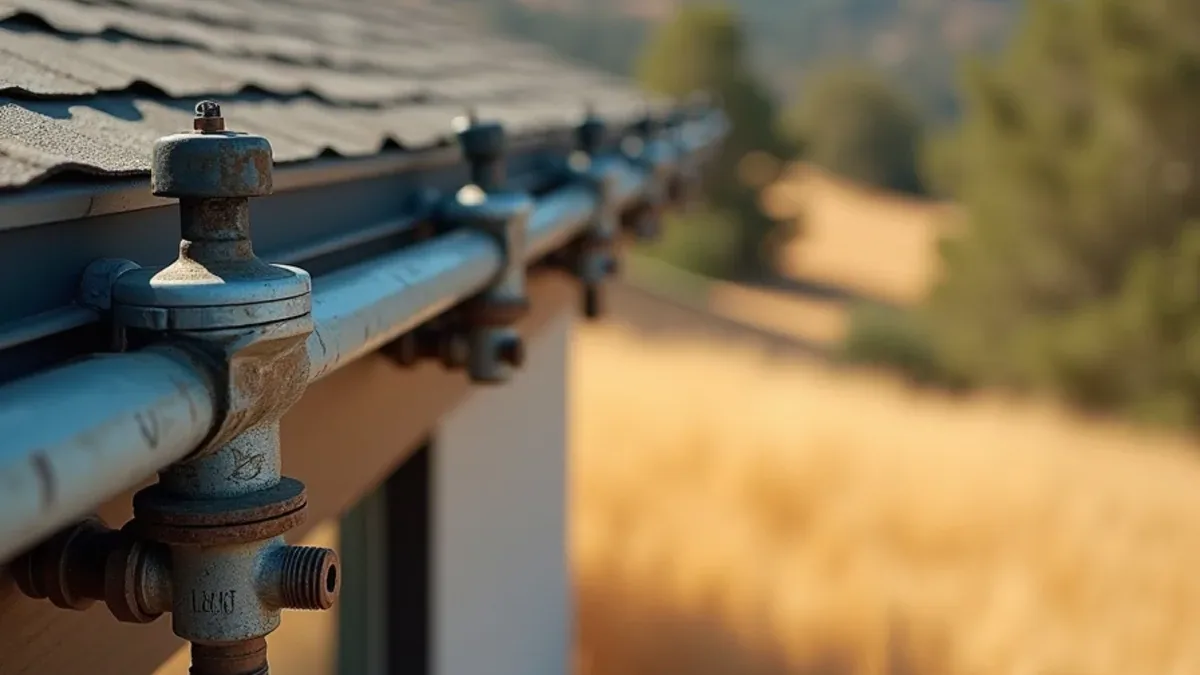
Exterior ember-defense sprinkler and misting systems are increasingly common on ridge properties, and they are a sensible investment. They are also, in our experience, an under-appreciated source of water damage.
The reason is straightforward: these systems sit unused for eleven months of the year.
- Exposed risers and fittings weather in hard UV and cold nights.
- Galvanized threads corrode.
- Plastic components go brittle.
- Solenoid valves stick, either closed — so the system fails when you need it — or open.
- Rodents nest in and chew flexible lines.
When something finally lets go — often on a seasonal test, or on an automatic trigger — it discharges into a wall assembly, under a soffit, or against a foundation. And because these are exterior systems on properties that are often unoccupied during the day, nobody notices for hours.
Exposure 3: post-fire hydrology
This is the longest-lasting one, and it applies even if your own property never burns.
Fire changes how ground handles water. Intense heat can create a hydrophobic layer in the soil — a water-repellent zone an inch or two down formed from vaporized organic compounds condensing as the ground cools. Vegetation that would have intercepted rainfall and held soil is gone. The result is that burnt slopes shed water rather than absorbing it.
The practical consequences last several seasons:
- Runoff volumes increase dramatically from the burned catchment. The same rainfall produces far more surface water than it did before.
- Debris flow risk rises sharply. A fast-moving slurry of water, soil, rock and vegetation carries far more force than water alone and damages structures rather than just wetting them.
- Drainage systems downstream are overwhelmed. Culverts, area drains and channels sized for pre-fire conditions cannot cope.
- Ash and sediment block everything — grates, gutters, culverts — precisely when they are most needed.
If a fire burns anywhere upslope of your property, treat the following winter as a materially different situation. See storm damage cleanup and, for canyon-bottom properties, the Canyon Road page.
The insurance picture
Fire suppression water is generally covered as part of the fire loss — it results directly from a covered peril.
A sprinkler system failure is generally covered as sudden and accidental discharge, in the same way as any plumbing failure, provided it was sudden rather than a long-running seep.
Post-fire debris flow and runoff is surface water, and therefore generally excluded from a standard homeowners policy. This one catches people badly, because it arrives as a consequence of a fire they associate with insurance coverage. It needs a flood policy. If you are below a burned slope, that is worth arranging well before the season — NFIP policies carry a 30-day waiting period.
See flood insurance vs homeowners insurance and the Upper Happy Valley area page.
Frequently asked
Does fire suppression cause more damage than fire?
Frequently, yes — particularly on a small, quickly contained fire. Suppression delivers thousands of gallons at pressure in a short time, and that water goes through ceilings, into wall cavities, along ducting, down stairwells and into the crawl space, well beyond the burnt area. It needs the same monitored structural drying as any water loss, and it is the part most likely to be under-scoped because attention is on the burnt section.
Can defensible space sprinklers leak?
Yes, and it is more common than people expect because these systems sit unused for eleven months a year. Exposed risers and fittings weather in hard UV, galvanized threads corrode, plastic goes brittle, solenoid valves stick, and rodents chew flexible lines. When something lets go on a seasonal test or an automatic trigger it discharges into a wall assembly or foundation, often with nobody home to notice.
Why does flood risk increase after a wildfire?
Intense heat creates a hydrophobic layer in the soil an inch or two down, formed from vaporized organic compounds condensing as the ground cools, and the vegetation that would have intercepted rainfall is gone. Burnt slopes therefore shed water rather than absorbing it, producing dramatically higher runoff from the same rainfall, a sharp rise in debris flow risk, and drainage systems overwhelmed by volumes they were never sized for. The effect lasts several seasons.
Is post-fire debris flow covered by insurance?
Generally not by a standard homeowners policy — it is surface water, which is excluded and requires a separate NFIP or private flood policy. This catches people badly because it arrives as a consequence of a fire they associate with coverage. If you are below a slope that has burned, arrange a flood policy well before the season, since NFIP policies carry a 30-day waiting period before coverage takes effect.