
The short answer
Oak and bay roots find the joints in old clay and cast-iron laterals, and on Lafayette’s wooded lots those laterals are long and the canopy is dense. Rootering buys months, not years. A camera inspection tells you where the intrusion is, and lining fixes it without trenching the driveway.
On the wooded lots through Happy Valley, Reliez Valley, Oak Hill Road and across into Orinda and Moraga, root intrusion into sewer laterals is the single most predictable expensive failure there is. It is not bad luck, and it is not specific to any one property. It is what happens when you put century-old trees over sixty-year-old pipe in a summer-dry climate.
Why these particular trees
Two species dominate the canopy here, and both are unusually effective at finding buried water.
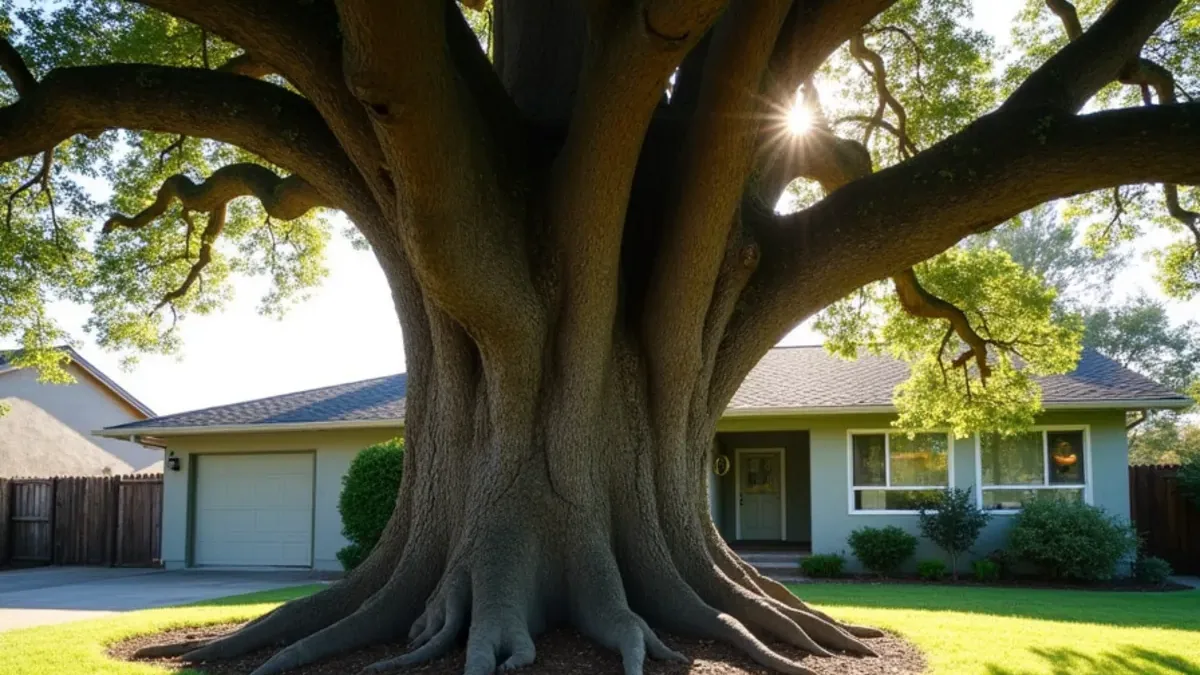
Coast live oak (*Quercus agrifolia*) is evergreen, drought-adapted, and long-lived. Its root system is broad and relatively shallow, extending well beyond the drip line, and it is optimized to exploit intermittent moisture in a climate with no summer rain.
California bay (*Umbellularia californica*) is similarly aggressive and tolerates wetter conditions, so it is frequently found along drainage lines — which is exactly where sewer laterals run.
The critical factor is our dry season. In a climate with summer rainfall, a root has moisture options everywhere. Here, from roughly May to October, the soil dries out and any consistent moisture source becomes disproportionately attractive. A sewer lateral weeping slightly at every joint is, from a root's perspective, the only reliable water for many feet in any direction.
How the intrusion actually develops
- Year zero. An older vitrified clay or cast-iron lateral weeps a small amount at every mortar joint. This is normal for pipe of that age and material.
- Years 1–3. Fine feeder roots detect the moisture gradient and grow toward it. A hair-fine filament finds the joint gap and passes through.
- Years 3–8. Inside the pipe the root finds constant water, nutrient and no competition. It proliferates into a mass of fine roots spanning part of the bore.
- Years 8–15. The root mass thickens. Solids and paper catch in it. Flow slows — the first slow drain, the first gurgle.
- One particular day. The mat catches enough material to block the line completely. Waste water surfaces at the lowest fixture in the house.
That final step is why it feels sudden after fifteen years of nothing. See sewage backing up into the shower.
Why Lafayette lots make it worse
- Long laterals. Larger parcels mean the run from house to main is long, with many more joints for roots to find.
- Old pipe. Much of the housing dates from the 1950s to 1970s, so original clay and cast iron is past design life.
- Slope. Hillside laterals have more elevation change and more opportunity for joint stress and offset as ground moves.
- Ground movement. Expansive clay soil swells and shrinks seasonally, working joints open over decades.
- Mature canopy. These are not young trees. A century-old oak has a root system to match.
What it costs when it goes
A lateral backup is Category 3 from the first minute. That means containment, negative air, full PPE, removal of every porous material the water touched, detergent cleaning followed by EPA-registered antimicrobial, regulated disposal, odor source removal and post-remediation verification.
Mitigation runs roughly $7.00 to $7.50 per square foot — about double a clean-water loss — before any rebuild. And because more material comes out, more has to go back. See sewage cleanup and backup removal and sewage backup cleanup costs.
Fixing it without losing the tree
This is the part worth being clear about, because people assume the choice is the oak or the plumbing. It very rarely is.
The vulnerable component is the pipe. A modern sealed lateral — properly jointed PVC or a cured-in-place liner — is not susceptible to root intrusion, because there are no weeping joints to attract roots and no gaps to enter through.
| Option | Tree impact | Longevity |
|---|---|---|
| Rootering | None | 12–24 months |
| Chemical root treatment | Minimal if applied correctly | Slows regrowth only |
| Spot repair by excavation | Some root disturbance at the dig | That joint only |
| CIPP pipe lining | None — no excavation | Long term; seals every joint |
| Full replacement by trenching | Significant root disturbance | Long term |
| Pipe bursting (trenchless replacement) | Minimal — pits at each end only | Long term |
Lining and pipe bursting are frequently the right answers on a Lafayette lot: they seal or replace the line without trenching through a mature root plate, and they do not require removing the tree that is the reason you bought the house.
What to do if you have mature oaks
- Get a camera inspection if the house is on its original lateral. Particularly worth doing at purchase — it costs a small fraction of one cleanup.
- Act on the early signs — a slightly slow drain, a gurgle, multiple fixtures slow together. See tree roots in your sewer line: warning signs.
- Keep grease and wipes out, so a partly restricted line does not become a blocked one.
- Know where your cleanout is before you need it.
- Fix the pipe, not the tree.
See the Happy Valley area page for how this plays out in the neighborhood where we see it most.
Frequently asked
Why do tree roots get into sewer lines in Lafayette specifically?
The dry season. From roughly May to October there is no rainfall, so soil dries out and any consistent moisture source becomes disproportionately attractive to roots. An older clay or cast-iron lateral weeping slightly at every joint is the only reliable water for feet around. Coast live oak and California bay are both broad-rooted, drought-adapted species optimized for exactly that kind of exploitation.
Do I have to remove my oak tree?
Almost never. The vulnerable component is the pipe, not the tree — a modern sealed lateral in properly jointed PVC or a cured-in-place liner has no weeping joints to attract roots and no gaps to enter through. Lining and trenchless pipe bursting both resolve the problem without trenching through a mature root plate or removing the canopy that makes the property what it is.
How long does root intrusion take to block a line?
Typically eight to fifteen years from first entry to full blockage. Fine roots find the joint within a few years, proliferate inside where there is constant water and nutrient, and gradually thicken into a mat. The mat itself does not block the line — it catches solids and paper, and that is what blocks it, which is why the failure feels sudden after years of nothing much.
Is rootering every couple of years an acceptable maintenance approach?
It is a decision to keep paying for the symptom. Rootering clears the mat so the line drains, but every entry point at every joint remains and the roots regrow within twelve to twenty-four months. Meanwhile each cycle brings you closer to a Category 3 backup, which costs many times more than lining the pipe would have. A camera inspection tells you where you actually are.