
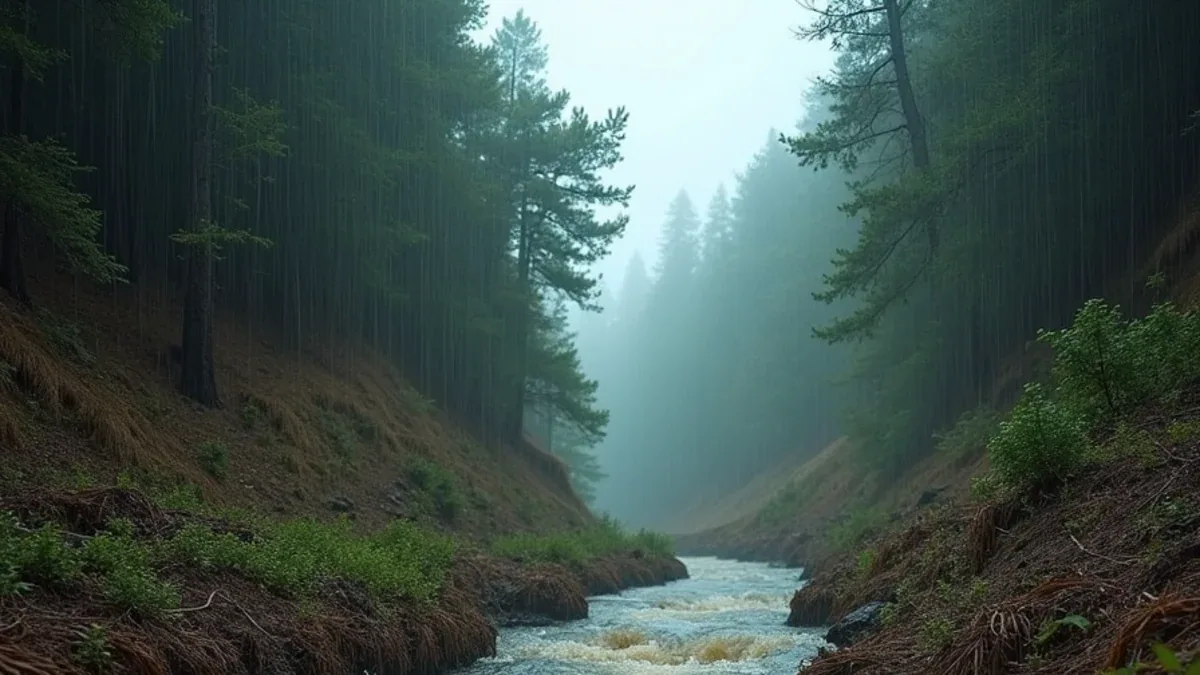
The short answer
Canyon lots collect runoff from slopes on both sides, so rainfall a flat lot would absorb arrives concentrated and fast. Storm water is also excluded from standard homeowners policies. The practical protections are drainage capacity sized for the catchment above you, and culverts cleared before the season rather than after.
The Canyon Road corridor running south from Lafayette toward Moraga has a water risk profile that is different in kind from the rest of the town, not merely in degree. It is worth understanding precisely, because the correct response differs too.
The geometry problem
On a typical hillside lot, water arrives from the slope above and disperses laterally across the property. Volume at any point is roughly proportional to the ground directly uphill.
In a narrow canyon, slopes on both sides feed the same low ground. Volume at the canyon bottom reflects the entire upstream catchment, and that catchment can be many times the area of any individual property.
Two consequences follow, and both are what make canyons genuinely different.
Speed. A canyon has a short response time. A seasonal drainage that is a dry gully in September can be running hard within an hour of a serious atmospheric river starting, because the water has a short distance to travel and steep gradients to travel it on. There is much less warning than the same rainfall would give on open ground.
Load. Canyon flow carries material. Leaf litter, branches, soil, gravel, occasionally larger debris off the slopes. That material is what turns a manageable flow into an event.
Blockage is the real mechanism
Nearly every serious canyon flooding event we have attended involved a blockage as much as a volume of water.
A culvert under a driveway or a road, a channel constriction, a grate, a fence line across the flow path — any of these catches the branches and litter the flow is carrying, then catches more, and within minutes the flow is going somewhere it was never intended to go. Often that is across a road, into a driveway, or against a building.
This is also why canyon flooding can happen in a storm that was not exceptional. The rainfall was ordinary; the blockage was not.
Debris flow is a different thing from flooding
Worth distinguishing clearly, because the safety implications differ.
Flooding is water arriving where it should not be. Debris flow is a fast-moving slurry of water, soil, rock and vegetation coming off a steep slope. It carries far more mass and momentum than water alone, and it damages structures rather than just wetting them.
It requires steep slopes, saturated or hydrophobic soil, and intense rainfall — conditions a canyon assembles by definition. And where a fire has burned on the slopes above, the risk rises sharply for several seasons because burnt ground repels water instead of absorbing it. See wildfire zone water damage risks.
What canyon-bottom owners can actually do
- Know your flow path. Walk the property during the first serious storm of the season and see where water actually goes. It is not always where you would expect.
- Keep every culvert and channel on your property clear before the season, and check them after each major storm.
- Report blockages on public culverts to the county or the relevant agency, with dated photographs.
- Keep debris out of the channel. Green waste, prunings and stacked material near a drainage line become the blockage.
- Have a flood policy. This is the clearest case for one in our entire service area — see below.
- Have an evacuation plan including a second route out where one exists, and go early rather than late.
- Watch the fire situation upslope. A fire above the canyon changes the following winter materially.
The insurance position, plainly
Surface flooding, including creek overflow and canyon flow, is not covered by a standard California homeowners policy. It requires separate NFIP or private flood insurance, and NFIP policies carry a 30-day waiting period, so buying one when the forecast turns does not work.
What may be covered is damage from a sudden accidental failure of the building during the same event — wind removing roofing, debris breaking a window, a supply line failing. We document the entry path, source and timing precisely so a covered element is not denied along with the excluded one.
If your property is in the canyon bottom and you do not have a flood policy, that is the single highest-value thing on this page.
The cleanup, when it happens
Canyon flooding is Category 3 without exception — the water has crossed open ground and road surfaces and may include sewage if any lateral surcharged upstream. It also always leaves solids behind, so the job starts with shovel work as much as pump work.
Slope assessment before entry, pump out, remove mud and vegetation, remove contaminated porous material, clean and disinfect, dry to a documented standard, and then a hard look at the culvert or channel that failed. See flood cleanup and the Canyon Road area page.
Frequently asked
Why do canyon homes flood faster than other properties?
Geometry. Slopes on both sides feed the same low ground, so the volume arriving at the canyon bottom reflects the whole upstream catchment rather than the rain falling on your property. The response time is also short — a gully that is dry in September can be running hard within an hour of a serious storm starting, because the water has a short distance to travel on steep gradients.
What is debris flow and how is it different from flooding?
Debris flow is a fast-moving slurry of water, soil, rock and vegetation coming off a steep slope, carrying far more mass and momentum than water alone — it damages structures rather than just wetting them. It needs steep slopes, saturated or hydrophobic soil and intense rainfall, which a canyon assembles by definition. Where a fire has burned above, the risk rises sharply for several seasons.
Is canyon flooding covered by homeowners insurance?
No. Surface flooding, including creek overflow and canyon flow, is excluded from standard California homeowners policies and requires separate NFIP or private flood insurance. NFIP policies carry a 30-day waiting period, so it must be arranged well before the season. Damage from a sudden accidental building failure during the same event — wind removing roofing, debris breaking a window — may still be covered.
What should I do if water is rising in the canyon right now?
Leave. This is the one situation in our service area where the honest advice is evacuation rather than mitigation, because rising canyon water and debris flow move faster than you can react and a single access road can be cut in both directions. Do not stay to move belongings or run a pump. Call for restoration afterwards — that part will wait.