
The short answer
Look on the exterior wall nearest the street, usually beside the hose bib, or on the street-side wall inside the garage. Lever handles turn ninety degrees; round handles turn clockwise several times. Find it and turn it now, while nothing is wrong — a seized valve discovered mid-emergency is useless.
Nearly every large water loss we attend includes some version of the same sentence: "it took us twenty minutes to find the shutoff." At several gallons a minute, twenty minutes is a hundred-plus gallons through the building.
This is a fifteen-minute job on a dry Saturday, and it is the highest-return maintenance task in any house.
You have three or four shutoffs, not one
| Valve | Where it is | What it isolates |
|---|---|---|
| Fixture shutoff | Behind each toilet, under each sink, behind the washer | That one fixture |
| Water heater cold inlet | On the pipe entering the top of the tank | The entire hot side of the house |
| House main | Exterior wall nearest the street, or the street-side garage wall | The whole house |
| Meter valve | In a box at the property line near the sidewalk | Everything, including irrigation and any leak between the meter and the house |
In an emergency you work down that list. The fixture valve is fastest if you can see the source; the meter valve always works.
Finding the house main
On a typical Lafayette property, water enters from the street side. So does the main shutoff. Look in this order:
- The exterior wall closest to the street, at or just above ground level. Frequently within a few feet of a hose bib on that side — the hose bib is often teed off just downstream of the main valve.
- Inside the garage, on the wall nearest the street, often behind or near stored items.
- In a small access panel or box set into an exterior wall.
- Under the house at the point of entry, on a raised-foundation property — less convenient but common on older hillside stock.
What you are looking for: either a lever (turns ninety degrees, closed when the lever sits across the pipe) or a round wheel handle (turns clockwise, several full turns to close).
Finding the meter valve
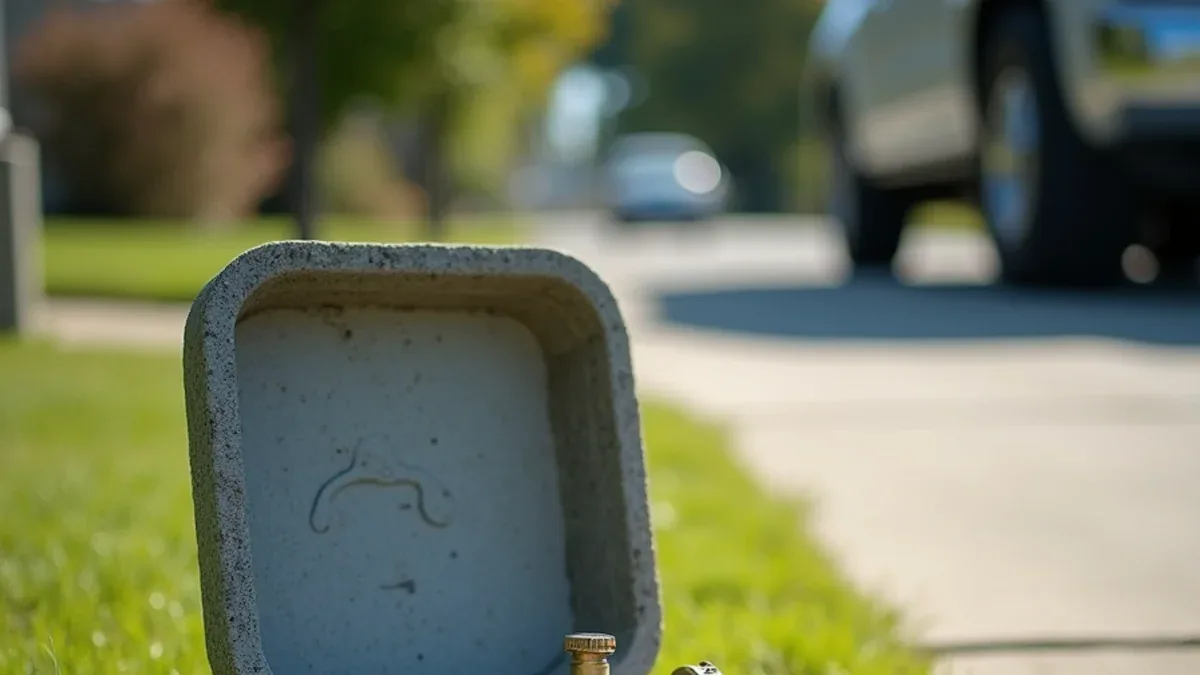
Look for a rectangular concrete or plastic lid set flush into the ground near the sidewalk or the property line, usually marked WATER. Lift the lid — a screwdriver in the notch helps, and check for spiders before you put a hand in.
Inside you will see the meter and, on the street side of it, a valve with a flat tab or a lug rather than a handle. Turning that tab so it lies crosswise to the pipe closes it. It needs a meter key — an inexpensive L-shaped tool from any hardware store — or a large adjustable wrench.
Test it — this is the part everyone skips
Finding the valve is not the same as having a working valve. Gate valves that have not moved in twenty years seize routinely, and you do not want to discover that during a flood.
- Turn the main fully off.
- Open a tap inside and confirm the flow stops after the residual drains.
- Turn the valve fully back on, slowly.
- Check for weeping around the valve stem afterwards — old packing sometimes leaks slightly after being moved, and it is a simple fix.
If it will not turn, do not force it hard enough to snap the stem. A broken valve stem is worse than a stiff one. Have a plumber replace it — a quarter-turn ball valve is the right modern replacement and it will still work in twenty years.
Then tell everybody
A shutoff only you can find is half a solution. Photograph the valve and the meter box, and send both photos to everyone in the household with a one-line description of where they are. Put a label on the valve. If you have a house-sitter or renters, include it in the handover.
While you are out there: the five-minute leak test
You are already at the meter, so do this. Turn off every water-using fixture and appliance in the house — including the ice maker and the irrigation controller. Note the meter reading, or watch the small triangular or star-shaped leak indicator.
Wait thirty minutes with nothing running. If the reading has moved, or the indicator is turning at all, you have a leak somewhere between the meter and the house. On larger landscaped properties, shut the irrigation valve specifically and repeat to isolate it. See leak detection services.
One upgrade worth considering
An automatic shutoff valve — a flow-monitoring device installed on the main that closes automatically when it detects a pattern consistent with a leak — is the closest thing to real insurance against this whole category of problem. They are particularly worth it for a house that sits empty during the day, or a property you leave for weeks at a time.
Some carriers offer a premium discount for them. It is worth asking, particularly in an area like Walnut Creek where the housing cohort produces a high volume of supply-line failures.
Frequently asked
Where is the main water shutoff valve in a typical house?
On the exterior wall closest to the street, often within a few feet of a hose bib on that side, or inside the garage on the street-side wall. On older raised-foundation properties it is sometimes under the house at the point of entry. If you cannot find it, the meter valve at the property line always works — it is in a box near the sidewalk and needs a meter key.
What if my shutoff valve will not turn?
Do not force it hard enough to snap the stem — a broken valve is worse than a stiff one. Use the meter valve instead for the immediate emergency, then have a plumber replace the house main with a quarter-turn ball valve, which does not seize the way old gate valves do. Testing your valve on a dry day is exactly how you discover this before it matters.
Do I need a special tool for the meter valve?
A meter key — an inexpensive L-shaped tool from any hardware store — or a large adjustable wrench. The valve has a flat tab or lug rather than a handle, and you turn it so the tab lies crosswise to the pipe. Buy the key now and keep it in the garage; improvising with pliers at 2 a.m. is how people round off the lug and lose the option entirely.
Is it bad to leave the water main off while I am away?
No, and for trips longer than a few days it is a sensible habit. Turn it off, then open a tap briefly to relieve pressure. The only things to consider are an automatic irrigation system and an ice maker, both of which simply will not run, and any fire sprinkler system, which is on a separate supply and must never be shut off.