
The short answer
Ten minutes, six places: under every sink, behind the toilets, the water heater and its pan, the washing machine hoses, the refrigerator and dishwasher connections, and the water meter with everything off. You are looking for damp, corrosion, mineral crust, and a leak indicator that should not be turning.
The expensive water losses are not the dramatic ones. They are the small ones that ran for months because nobody looked. This walkthrough takes ten minutes and needs a torch and your hands.
Do it monthly and you will find things while they are still a $15 part.
Under every sink — 3 minutes
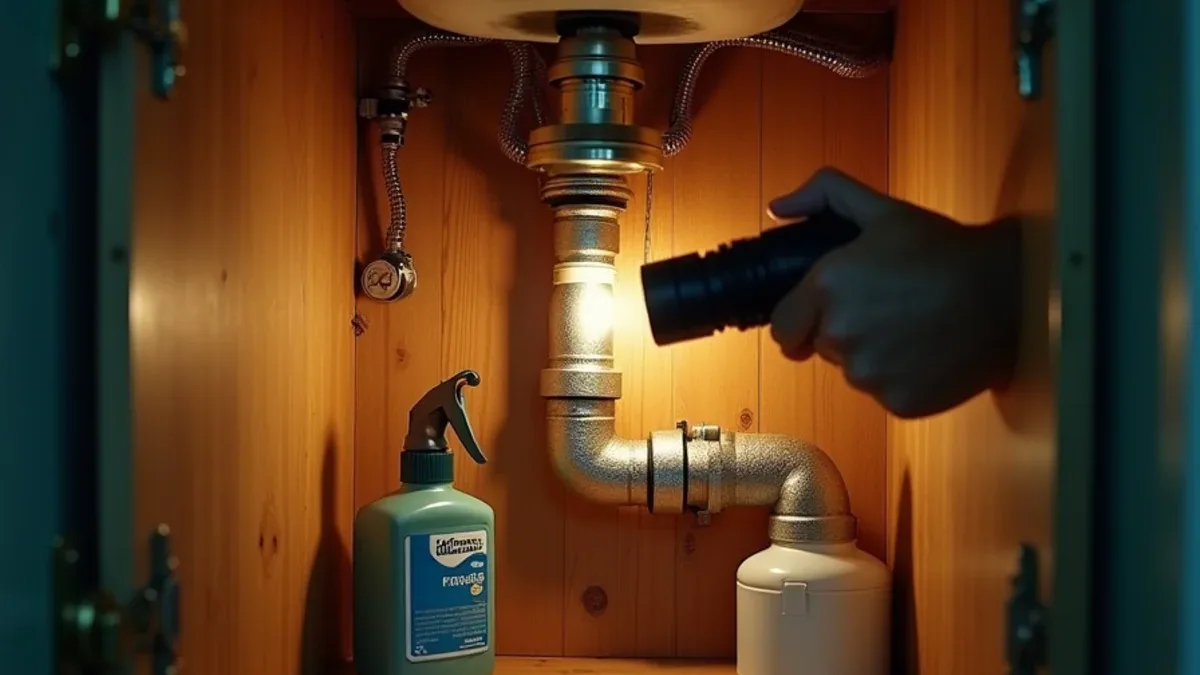
Kitchen, every bathroom, laundry, wet bar. Clear the cleaning products out and get a torch in there.
- Feel the connections — the angle stops, the braided supply lines, the P-trap joints. Dry is good. Any dampness is not.
- Look at the cabinet base. Water staining, swelling, or a dark line at the back corner. Particleboard swells before it fails and the swelling is visible.
- Check the braided lines for corrosion or bulging. They have a five to ten year life. Write the date on them when you replace them.
- Look for white mineral crusting at a joint — that is a slow weep that has been evaporating.
- Run the tap and the drain while you watch the P-trap. Some leaks only appear under flow.
Toilets — 1 minute each
- Feel around the base for damp. A failing wax ring leaks slowly into the subfloor and rots it out before anything shows on the surface.
- Rock the bowl gently. Any movement means the flange or the floor beneath is compromised.
- Check the angle stop and supply line behind it.
- The food coloring test — a few drops in the cistern, wait twenty minutes without flushing, look in the bowl. Color means the flapper is leaking, which is the most common cause of an unexplained water bill.
The water heater — 1 minute
- Look at the base of the tank. Any water there with no fitting leak above means the shell has corroded through — that tank needs replacing now.
- Check the T&P relief discharge pipe for signs of discharge.
- Check the fittings at the top for drips or corrosion.
- Look at the strapping — two straps, upper and lower third, anchored into studs. See California's water heater strapping law.
- Listen. Rumbling or popping means sediment on the tank floor.
Appliances — 2 minutes
- Washing machine hoses. Feel along them for bulging or softness, check the connections at both ends, and look at the floor behind the machine.
- Dishwasher. Look at the floor at the front edge and under the adjacent cabinet toe-kick, and check the supply connection under the sink.
- Refrigerator ice-maker line. Pull the fridge out occasionally and check the small plastic or copper line at the back — a very common slow leak.
- Under the washer and dryer. Pull them out twice a year. The floor there is where water sits longest.
Ceilings, walls and floors — 2 minutes
Walk the house and look up and down.
- Ceiling stains, particularly below bathrooms and in the top-floor rooms.
- Bubbling paint or lifting tape seams on walls — moisture from behind.
- Baseboards that look swollen or have separated from the wall.
- Flooring that is cupping, lifting or feels soft underfoot.
- A warm patch on a slab floor — walk barefoot occasionally. It is the classic hot-water slab leak sign.
- Grout and silicone in showers, for gaps or crumbling.
Use your nose — 30 seconds
Open closets, particularly ones on exterior walls or over a crawl space, and smell. A musty smell in an enclosed space with nothing visible is one of the most reliable early indicators there is. See why your house still smells musty.
Quarterly: the meter test
Not monthly, but four times a year. Turn off every water-using fixture and appliance including the ice maker and irrigation, note the meter reading, wait thirty minutes, check again. Any movement means a leak.
Why bother
Because the difference between finding a weeping angle stop and finding the damage it caused is roughly the difference between fifteen dollars and fifteen thousand. Everything in restoration scales with how long the water ran, and that is the one variable a homeowner controls completely.
See leak detection services if something on this list turns up and you cannot locate it, and the Moraga area page for the local housing context.
Frequently asked
How often should I check my house for leaks?
A ten-minute walkthrough monthly — under sinks, toilets, the water heater, appliances, and a look at ceilings, walls and floors — plus a meter test quarterly. Pull the washer, dryer and refrigerator out twice a year to check behind them. It sounds like a lot written down; in practice it becomes a quick habit and it catches problems while they are still a cheap part.
What is the most commonly missed leak in a house?
The refrigerator ice-maker line. It is a small plastic or copper line behind an appliance nobody moves, it weeps slowly for months, and the water goes under the flooring and into the cabinet run alongside. Close seconds are the toilet wax ring, which rots the subfloor before anything shows on the surface, and the connection behind a washing machine.
How do I check if my toilet is leaking?
Two checks. For the flapper, put a few drops of food coloring in the cistern, wait twenty minutes without flushing, and look in the bowl — color means water is passing, which is the most common cause of an unexplained bill increase. For the base, feel around it for damp and rock the bowl gently; any movement means the flange or the subfloor beneath is compromised.
Are water leak alarms worth it?
Very much so, for the price. Floor-level alarms under every sink, behind the washer, beside the water heater and near the dishwasher cost under $20 each and turn an eight-hour leak into a one-hour leak — which on a supply-line failure is the difference between a mop and a restoration job. An automatic shutoff valve on the main is a bigger investment and worth considering for a house that sits empty during the day.