
The short answer
Close both laundry valves behind the machine — or the house main if they will not turn — then unplug the washer, pull it forward and photograph the failed hose before it goes anywhere. Braided stainless hoses are a five-to-ten-year part, not a lifetime one, and they fail at full pressure.
The washing machine supply hose is, statistically, one of the most reliable ways for a house to flood. Not because the part is badly made, but because of where it sits and what is asked of it: under full mains pressure continuously, behind an appliance nobody moves, in a room people are rarely in.
A failed hose discharges at the same rate as a burst pipe. If it happens at 9 a.m. on a workday, it runs until someone gets home.
Step 1: shut off the hose bibs behind the machine
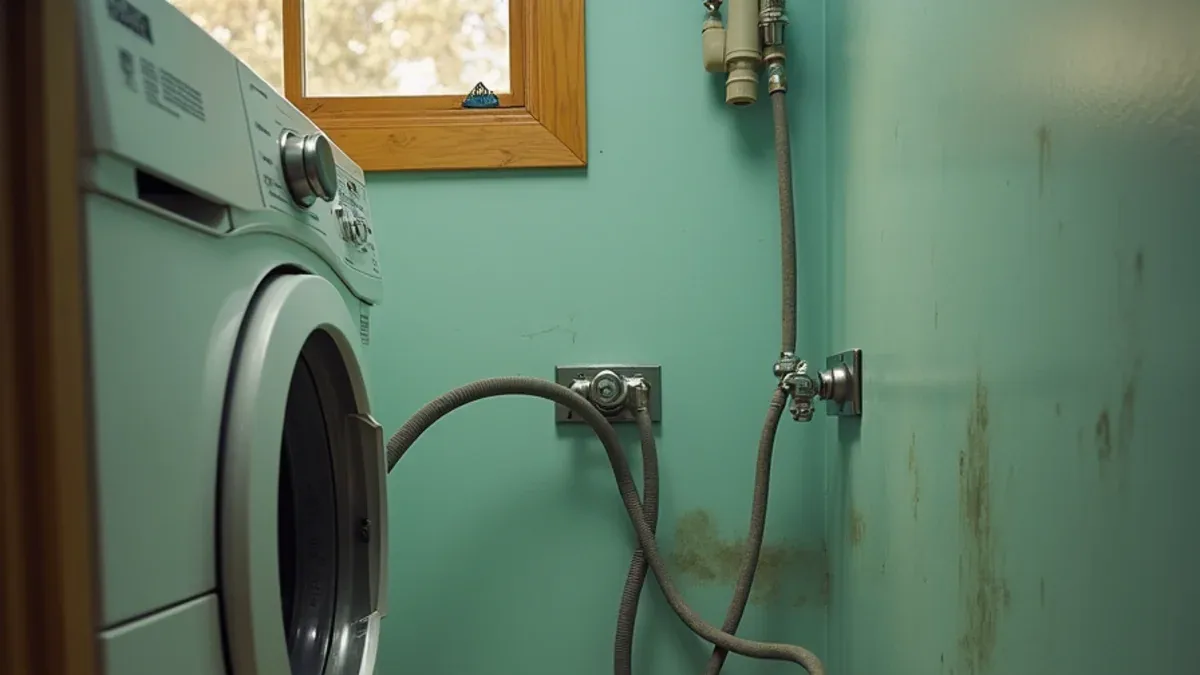
There are two — hot and cold — on the wall behind the washer, usually in a recessed box. Turn both clockwise until they stop. If the machine is pulled out far enough to reach behind it, this takes ten seconds.
If you cannot reach them, or the valves are seized, go to the house main. On most properties that is on the exterior wall closest to the street, and the meter valve at the property line is the fallback that always works.
Step 2: cut power to the laundry circuit
The washer is plugged in at floor level, and in most laundry rooms so is the dryer. If water has reached either, switch that circuit off at the panel before you go anywhere near the appliances. Do not stand in water to do it.
Step 3: photograph the hose itself
Before you pull the hose off or throw it away. A photograph of the split rubber, still connected, is the evidence that establishes a sudden accidental failure — which is exactly what a standard homeowners policy covers.
Then the room: wide shots, the water extent, the base of every wall it reached, the flooring, and anything stored on the floor.
Step 4: check where the water actually went
Laundry rooms are almost always adjacent to something else, and water follows the floor slope rather than staying put. The three places to check:
- Under and behind the machines. Pull them out. The floor under a washer is where water sits longest and where nobody looks.
- The rooms sharing a wall. Water crosses under the bottom plate into a hallway, a bedroom closet or a bathroom within minutes.
- The level below, if the laundry is upstairs. An upstairs laundry failure is a two-floor loss more often than not, arriving through the ceiling — see ceiling water damage repair.
If the laundry is on a slab, also check the base of the drywall all around the room. Drywall wicks water upward six to twelve inches and holds it in the paper facing, which is where mold starts.
Step 5: get it extracted properly, not mopped
Mopping and towels remove surface water. If the water reached carpet, the pad underneath holds roughly a gallon per square foot. If it reached the subfloor, that is a different job again. And if it went under a vinyl or laminate floor, the moisture is trapped underneath with nowhere to evaporate.
Professional extraction plus monitored drying is what stops this becoming a mold job — see water extraction and removal and structural drying and dehumidification. Call +1 (201) 277-9344 and we can talk through whether you actually need us, honestly.
Preventing the next one — the cheapest fix in the house
This is one of the very few water damage risks you can essentially eliminate for the price of a takeaway meal.
- Replace rubber hoses with stainless braided. Rubber has a five to eight year service life and it degrades from the inside where you cannot see it. Braided stainless is a few dollars more and lasts far longer.
- Replace them anyway every five years or so, whatever they are made of, and write the date on them with a marker.
- Leave a gap behind the machine. A hose kinked hard against a wall fails at the kink.
- Turn the taps off if you are away for more than a few days. This is the single highest-value habit for anyone who travels.
- Fit a floor-level water alarm behind the machine. Under $20.
- Consider an automatic shutoff valve — a flow-monitoring valve that closes on an abnormal pattern. Genuinely effective for a house that sits empty during the day.
On the 1960s and 1970s housing across Springhill and the rest of mid-century Lafayette, the laundry hoses are frequently as old as the copper — which is to say, well past anything anyone would call a service life.
Frequently asked
How often should washing machine hoses be replaced?
Rubber hoses every five years or so; stainless braided last longer but are still worth replacing on roughly the same cycle. Rubber degrades from the inside where you cannot inspect it, so age matters more than appearance. Write the installation date on the hose with a marker so the next person — including future you — knows.
Are stainless braided hoses actually better?
Yes, meaningfully. The braid restrains the inner tube so a weak point cannot balloon and rupture the way plain rubber does, and the failure mode when they do eventually go tends to be a seep rather than a burst. They cost a few dollars more than rubber. It is one of the best returns on spend anywhere in a house.
Should I turn the washer taps off between loads?
Between loads is more than most people will sustain, but turning them off whenever you go away for more than a couple of days is genuinely worth the habit. A hose that fails while the house is empty runs for days rather than hours, and that is the difference between a laundry room and a whole-floor loss.
The floor is wet but it seems minor. Do I need a professional?
It depends what the water reached. If it stayed on sealed tile or vinyl and you got it up within the hour, you are probably fine. If it reached carpet, crossed under a wall into another room, went under a laminate or vinyl plank floor, or the laundry is upstairs, get it checked — carpet pad holds about a gallon per square foot and trapped moisture under a floating floor has nowhere to evaporate.