
The short answer
EBMUD water is good water — largely Sierra snowmelt through the Mokelumne system. It is not why your copper fails. Pinhole perforation is driven by four factors and pipe age dominates: mid-century Lafayette copper is now forty to seventy years into a service life of about that length.
Lafayette's water comes from the East Bay Municipal Utility District, drawn largely from Sierra snowmelt via the Mokelumne River system and supplemented by local reservoirs. It is good water by any reasonable standard, and EBMUD publishes annual water quality reports for anyone who wants the detail.
What interests us professionally is not whether the water is safe to drink — it is what the water does to the pipe carrying it, and what that means for when a house starts leaking.
What actually drives pipe failure
Copper supply lines fail through pinhole perforation from the inside out. Four factors drive it, and only some are in your control.
| Factor | What it does | Can you change it? |
|---|---|---|
| Water chemistry | pH, alkalinity, dissolved oxygen and mineral content affect corrosion rate | No — but conditioning is possible |
| Flow velocity | High velocity at elbows and fittings causes erosion corrosion | Yes, via pressure |
| Pressure | High static pressure raises velocity and stresses every fitting continuously | Yes — a regulator |
| Age and installation quality | Decades of service, plus workmanship at joints and supports | No, but you can plan for it |
| Mineral scale | Reduces bore, raises velocity, insulates water heater tanks | Partly, via conditioning and maintenance |
The one you can fix today: pressure
This is the highest-value thirty seconds in this article.
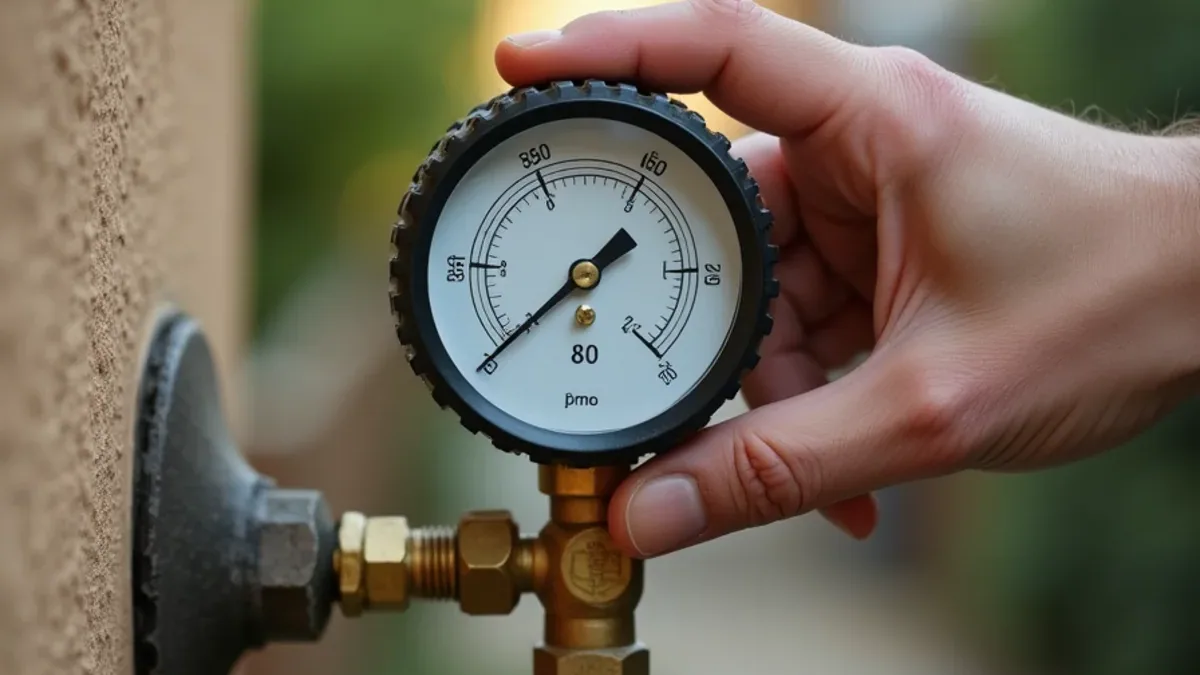
A water pressure gauge that screws onto an outdoor hose bib costs about fifteen dollars. Screw it on, open the tap fully, read the dial. That is your static pressure.
Anything over 80 psi is a code issue and it is over-stressing your entire plumbing system continuously — every joint, every angle stop, every braided connector, every appliance fill valve, and the water heater.
High pressure also raises flow velocity, which accelerates erosion corrosion at elbows and fittings — precisely where pinholes start. High pressure does not cause a leak today; it moves the date forward by years.
The usual cause of high pressure is a failed pressure regulator, which is a straightforward and inexpensive plumbing repair. Regulators have a service life of roughly ten to fifteen years and they fail quietly.
Hardness, scale and the water heater
Water in this region is moderately hard, and hardness has a specific and predictable effect on a water heater: dissolved minerals precipitate out of solution when heated and settle as sediment on the tank floor.
That sediment layer insulates the tank floor from the burner, which means longer heating cycles, higher energy use, and accelerated corrosion of the steel shell above the burner. The rumbling or popping sound in an older tank is water flashing to steam under that layer.
Flush the tank annually. It is a straightforward job and it meaningfully extends the life of a heater. See water heater leak cleanup for what happens when one is not maintained.
The other thing scale does
Scale also builds inside pipework, reducing the effective bore. A narrower bore at the same flow rate means higher velocity, and higher velocity accelerates erosion corrosion at every elbow and fitting downstream.
Scale also seizes valves. The shutoff you need in an emergency will not turn, because the mechanism has calcified — which is exactly the wrong moment to discover it. Exercise every shutoff valve in the house once a year: turn it fully off and fully on. Two minutes, and it keeps them working.
What this means for Lafayette housing
Much of the town was plumbed in copper between the mid-1950s and the mid-1970s. Copper supply lines have a practical service life in the range of forty to seventy years depending on all the factors above.
Which is to say: the whole cohort is now in the window. That is why pinhole leaks are one of our most frequent calls across Springhill, Burton Valley and the mid-century tracts generally. It is not that anything went wrong — it is that these systems have reached the end of a normal life. See burst pipe cleanup.
The practical list
- Check your static pressure with a hose bib gauge. Over 80 psi means the regulator needs attention.
- Flush the water heater annually to clear sediment.
- Exercise every shutoff valve once a year so scale does not seize them.
- Replace braided supply connectors every five to ten years.
- Do the meter leak test annually — everything off, note the reading, check thirty minutes later. See signs of a hidden water leak.
- Watch your EBMUD bill for a step change, which is the clearest early sign of a hidden leak.
- Read the annual water quality report if you want the detail on what is actually in the supply.
See the Downtown Lafayette area page for more on the local housing stock.
Frequently asked
Does EBMUD water cause pinhole leaks?
Water chemistry is one of four factors, alongside flow velocity, pressure and pipe age. EBMUD water is good by any reasonable standard, and copper pinhole failure across mid-century Lafayette housing is primarily a matter of age — these systems are forty to seventy years into a service life of about that length. What you can control is pressure and velocity, which move the failure date forward or back by years.
What water pressure should my house have?
Under 80 psi static. Above that is a code issue and it over-stresses every joint, angle stop, braided connector, appliance fill valve and the water heater continuously, while raising flow velocity and accelerating erosion corrosion at elbows. A pressure gauge that screws onto an outdoor hose bib costs about fifteen dollars and reads in seconds. High pressure usually means a failed regulator, which is inexpensive to replace.
How does hard water affect my plumbing?
Dissolved minerals precipitate out when heated and settle as sediment on a water heater tank floor, insulating it from the burner and accelerating shell corrosion — the rumbling in an older tank is water flashing to steam under that layer. Scale also builds inside pipework, reducing the bore and raising velocity, and it seizes shutoff valves so they will not turn when you need them.
What maintenance actually extends plumbing life?
Four things, none expensive. Check static pressure with a hose bib gauge and fix the regulator if it is over 80 psi. Flush the water heater annually to clear sediment. Exercise every shutoff valve once a year so scale does not seize it. And replace braided supply connectors every five to ten years — they are a few dollars each and they are the most common single point of failure in any house.