

Roof leaks are the most misdiagnosed water damage there is. Water gets in at one point, runs down the underside of the sheathing, crosses two or three rafter bays, soaks into insulation, and finally shows up on a ceiling several feet from where it entered.
We tarp it, dry what is above the ceiling, and work backwards to the actual entry point. Call +1 (201) 277-9344.
Signs you need roof leak water damage restoration
If you recognize two or more of these, the problem is already past the point where waiting is cheaper.
A ceiling stain that appears or grows during rain
Almost certainly the roof envelope rather than plumbing. Plumbing leaks do not care about the weather.
Damp or dark patches on attic sheathing
Water tracking down the underside of the deck. Trace it uphill to the entry point.
Compressed, darkened or fallen insulation
It has been saturated. It will not recover and it needs to come out.
A stain along the top of an exterior wall
Frequently gutter overflow backing up behind the fascia rather than a roof-field leak.
Daylight visible in the attic
An actual opening. Note where it is relative to a rafter and get it tarped.
Widespread attic damp with no single source
Often condensation from a bathroom fan venting into the attic, not a leak.
First: stop it getting worse
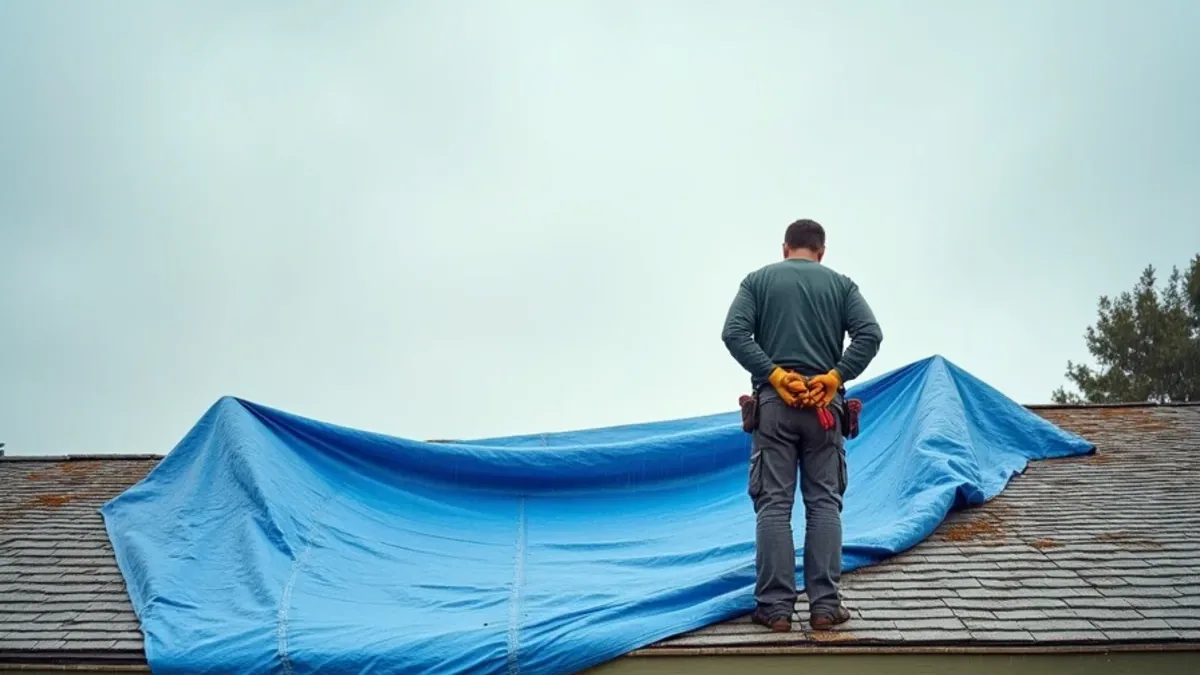
If the roof is open — wind lifted shingles, a limb came through, flashing tore away — the first job is a properly battened tarp, not a diagnosis. Every policy imposes a duty to mitigate, and a roof left open through the next system can genuinely reduce what a carrier pays on the additional damage.
Inside, while you wait: clear the room under the leak, turn off any light fixture on that circuit at the breaker, get a container under the drip, and photograph everything. See storm damage cleanup for the wider storm sequence.
Where Lafayette roofs actually leak
In our experience, the field of the roof — the open shingled area — is the least common failure point. It is nearly always a detail, a penetration or an intersection.
| Entry point | Why it fails | How obvious is it from inside? |
|---|---|---|
| Chimney and wall flashing | Sealant fails, step flashing corrodes or was never lapped correctly | Stain appears near the chimney chase — reasonably obvious |
| Skylight curb and flashing | Seals and gaskets degrade in UV; curbs are a classic weak point | Stain around the skylight well — obvious |
| Valleys | Debris dams up, water backs under the shingle courses | Can appear well away from the valley — not obvious |
| Plumbing vent boot | The rubber collar cracks after 10–15 years of UV | Small persistent stain, often first noticed on a top-floor ceiling |
| Lifted or missing shingles after wind | Wind-driven rain gets under the exposed course | Stain during storms only |
| Gutter overflow behind the fascia | Blocked with oak leaves, water backs up under the drip edge | Stain along an exterior wall top — commonly misdiagnosed |
| Condensation on cold sheathing | Bathroom fan venting into the attic instead of outside | Widespread damp and mold with no single point — not a leak at all |
That last row matters more than people expect. We are called out to "roof leaks" several times a year that turn out to be a bathroom extractor discharging into the attic, saturating the sheathing on the north plane where it dries slowest. Fixing the roof would not have helped.
The oak leaf problem
The mature coast live oaks that define these neighborhoods drop constantly and unevenly, and they do it into gutters, valleys and behind chimneys. A gutter packed with wet leaf litter is not just failing to drain — it is holding standing water against the fascia and the drip edge, and it is heavy enough to pull the gutter away from the roof.
On wooded lots through Happy Valley, Oak Hill Road, Reliez Valley and across Orinda and Moraga, gutter clearing in October is not maintenance advice — it is the single highest-return thing you can do before the rains.
What we do above the ceiling
Tarp or secure the opening
Battened tarp on the roof, or interior containment where roof access is unsafe.
Get into the attic and map it
Moisture meters on the sheathing and the rafters, thermal imaging where access is limited, and a look at the underside of the roof deck to trace the run back to the entry point.
Remove saturated insulation
Wet blown-in cellulose and fiberglass batts hold water, compress, and never recover their R-value. Out, bagged, and replaced later. Leaving it in is the most common reason a roof leak becomes an attic mold job.
Dry the sheathing and framing
Airflow and dehumidification into the attic space with the ventilation managed, and pin meter readings from the framing rather than the surface.
Deal with the ceiling below
Open, dry and repair — see ceiling water damage repair for how we handle texture matching and the pre-1980 acoustic ceiling question.
Check the walls the water ran down
Water that reached a top plate goes down a wall cavity. This is the most commonly missed part of a roof leak.
Treat, verify, reinstate
Antimicrobial on the framing while it is open, readings to the dry standard, then insulation, drywall and finishes. Permanent roof repair is coordinated with a roofing contractor.
Insurance: the roof-leak gray area
This is the water damage category most likely to be argued over, and it is worth understanding why. Standard California homeowners policies cover sudden and accidental damage. They exclude wear, deterioration and deferred maintenance.
- Wind lifted shingles and rain came in — normally covered, because a covered peril created the opening.
- A limb punctured the roof — normally covered, impact damage.
- A twenty-five-year-old roof finally leaked under three days of rain — commonly denied as wear and tear, even though the rain event was real.
- A vent boot cracked from UV over fifteen years — usually treated as deterioration, though the resulting interior damage is sometimes still payable.
What helps: dated photographs of the roof in sound condition before the event, records of maintenance and gutter clearing, and documentation that ties the damage to a specific storm date. We photograph the exterior cause and the interior damage as one evidence chain, and we write what we actually find — including when the honest answer is that the roof was at the end of its life.
You do not need to know what to ask for
You do not have to know whether this is roof leak water damage restoration, extraction, mitigation or a full restoration — those are stages of one job and sorting out which you need is our work, not yours.
A local person answers
Not a call center selling your emergency on to whoever bids for it.
First question
Has the water stopped? Everything about roof leak water damage restoration changes depending on whether it is still arriving.
Then we move
60-minute dispatch, and we talk you through the shutoff while the crew is loading.
Free, no-obligation inspection with moisture readings and a written assessment. We bill your insurer directly.
Our roof leak water damage restoration process
Six steps, documented at every stage, with the daily readings that prove it.
Secure the opening
Battened emergency tarp, or interior containment if the roof is unsafe.
Map the attic
Moisture readings and thermal imaging to trace the run back to the entry point.
Strip wet insulation
Saturated insulation removed and bagged before drying begins.
Dry sheathing and framing
Managed airflow and dehumidification with pin readings from the framing.
Repair the ceiling and walls
Open, dry, treat, then drywall, texture and paint.
Coordinate the permanent repair
Roofing contractor scheduled and briefed with our photographs of the entry point.
What drives the price
We are not going to quote a number over the phone — nobody can scope a water loss without walking the property. These are the factors that decide it.
- Emergency tarping
- Area, roof pitch and height. Steep hillside roofs need more rigging.
- Attic access and clearance
- A walkable attic is straightforward; a low-clearance truss attic is slow, confined work.
- Insulation replacement
- Square footage removed and reinstalled, plus disposal of the saturated material.
- Ceiling repair extent
- A single section versus a whole plane, and whether the texture is standard or specialty.
- Asbestos considerations
- Pre-1980 acoustic ceiling texture may need testing before demolition.
- Roof repair itself
- A separate roofing trade, ranging from a vent boot replacement to a full re-roof.
Why choose Water Lafayette for roof leak water damage restoration
Not the generic badges every restoration site carries — the things that actually change the outcome on this particular job.
Battened tarps, after dark if it is safe
Properly secured rather than weighted down, because a tarp that lifts in the next system has done nothing. Emergency tarping is a covered mitigation cost on virtually every policy.
We go into the attic and trace it uphill
Water enters at a flashing or valley and travels down the sheathing across rafter bays. Following the wet path back is the only way to find the entry point rather than guessing from the stain.
We check whether it is a leak at all
Several times a year the "roof leak" is a bathroom fan venting into the attic, condensing on the north-facing sheathing. Re-roofing would not have helped, and we say so.
Honest about the wear-and-tear line
Wind damage is covered; a twenty-five-year-old roof that finally leaked is usually not. We write what we find, including when the finding is unhelpful to the claim.
Coordinated with your roofer, photographs handed over
We secure and dry; the roofer does the permanent repair. They get our pictures of the entry point so nobody is searching a second time.
Licensed and insured California contractor · IICRC-certified to the S500 water damage and S520 mold remediation standards · 60-minute dispatch across Lafayette and Lamorinda · Based at 3450 Golden Gate Way, Lafayette, CA 94549.
Roof Leak Water Damage Restoration FAQs
Why is the ceiling stain nowhere near where the roof is leaking?
Because water runs. It enters at a flashing, a valley or a lifted shingle, travels down the underside of the roof sheathing, crosses rafter bays, soaks into insulation, and finally emerges at the lowest point or the first penetration — often a recessed light can, which acts as a drain. Tracing back from the stain requires getting into the attic and following the wet path uphill, which is exactly what we do before anyone touches the roof.
Will insurance cover my roof leak?
It depends on the cause. Wind that lifted shingles or a limb that punctured the roof are covered perils, and the resulting interior damage is normally payable. An old roof that finally leaked under sustained rain is commonly denied as wear and deferred maintenance. Emergency tarping and interior drying are almost always covered as mitigation regardless, so do not skip the tarp while you sort out coverage. Dated photographs of the roof in sound condition help enormously.
Does the wet attic insulation have to be replaced?
Yes. Saturated blown-in cellulose and fiberglass batts hold water for a very long time, compress permanently, and never recover their R-value. Leaving them in place is the most common reason a roof leak becomes an attic mold job three months later. They come out and get bagged, the framing and sheathing are dried and treated, and new insulation goes back once readings confirm the assembly is dry.
Can you fix the roof as well?
We do emergency tarping and board-up immediately, and we handle everything on the inside — attic drying, insulation, ceiling and wall repair. The permanent roof repair or re-roof is a roofing contractor's work, and we coordinate directly with yours or bring in one we work with regularly, handing over our photographs of the entry point so they are not searching for it.
My attic is damp everywhere but I cannot find a leak. What is going on?
Very often it is condensation rather than a leak, and the usual cause is a bathroom or kitchen extractor fan venting into the attic instead of through the roof or the eave. Warm moist air hits cold sheathing — worst on the north-facing plane, which dries slowest — and condenses across a wide area. Blocked soffit or ridge ventilation makes it worse. The fix is ducting and ventilation, not roofing, and we will tell you if that is what we find.
Related reading
Ceiling Leaking During a Storm? What to Do in the Next 30 Minutes
Wet drywall is heavy and it fails without warning. Before you do anything else, get out from under it — then work in this order.
ReadWinter Storm Prep Checklist for Hillside East Bay Homes
Every February callout we attend has an October job that did not get done. Here is the list, in the order that matters.
Read